I have a weird astrological natal chart. It is an odd experience walking the realms of science, spirituality and astrology since in the minds of many they are incongruous rather than related like they are to me and a growing handful of other physicists and neuroscientists, some who have been involved in psychedelic research, and others who were involved in studies of Eastern spirituality. Primarily, the work has been criticized by skeptics who have not studied consciousness in depth themselves, and their unawareness of this important realm which influences conscious behavior they have used to marginalize the scientists who have studied it. I am a scientist, but I am also an empath with conscious awareness of the unconscious world governing consciousness. I have an understanding of the planetary and elemental forces that allow for these phenomena, due to an independent postgraduate study of neuroscience, physics, cosmology and myself. As an empath it is difficult to know how to convey the science to someone who does not have our awareness of the world. I was telling someone the other day that I had to be extremely open minded and willing to examine my perceptions to learn the things I did. I also had to have a LOT of time to slow down and notice things I might not otherwise, like the nature of my thoughts and emotions, my dreams, the natural world, the movement of the planets, and the symbols in those places and in the collective consciousness (anyone else getting messages about monkeys?). The way these interact with my stream of consciousness gives me information about many questions I might have, which is fortunate because I have a lot of questions. I had to completely treat my neurological and hematological problems in order to achieve the ability to slow down and see and feel these things that are invisible to the anxious and overwhelmed. I was also able to do this because I had access to my personal genome through consumer genetics testing, and what I found regarding that is what made me wonder about free will.
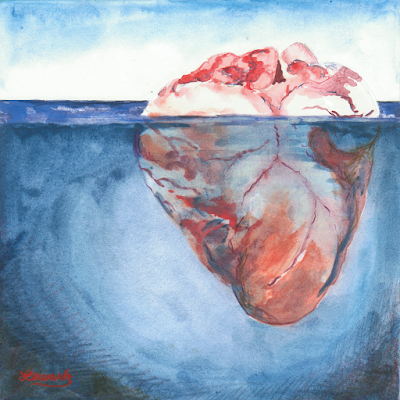 |
| What Would Jung Do? 8" x 8" Inktense on Paper, $5000 USD, Eighty percent of profits go to Loveland Sunrise Community Health |
In three days, I will have been without a full time paid job for 21 years. That doesn’t mean I wasn’t working. It’s no secret that being a mother and homemaker is a lot of responsibility, but I repeatedly took on more work in the interest of trying to strengthen my community. I used to like to say that I suffered from chronic volunteerism. I am still trying to get over it. I have a great deal of trouble not giving myself away, but I don’t think that’s because I actually want to die for the causes I believe passionately in. I struggle with qualities that people with Williams Syndrome have; they have a child-like view of love and connection, and can get into big trouble because of it. Musical gifts also run in my family. People with Williams Syndrome are missing an entire section of Chromosome 7. I am not missing that, but I do have some polymorphisms in RELN and OXTR which are on that part of Chromosome 7. The way consumer genetics testing works, not everything is tested - it is kind of a shotgun approach, so I don’t know about some of the other 22 genes, but I wonder because of the struggles I have if RELN and OXTR are important in creating some of the psychological and behavioral traits associated with Williams Syndrome.
My husband made enough income that it made up for me not making one, but it did not make up for being able to retire. Our plan was for me to go back to work when the kids left the house (which I am seeing could happen any day) and that we would save all of my income and some of his toward retirement. That is still on the table, but I would have to do something where I work from home because of my chemical sensitivity. It’s true that as an intuitive I could read Tarot for people, but I’m pretty sure that’s not what I am supposed to do, or what would make me happy. For one thing I don’t want to have anyone become dependent on me for guidance. I’d rather help people uncover their own intuitive gifts.
I feel like I understand the nature of precognitive dreams pretty well since I had experiences with it as a child that at the time I knew were real, but then grew to doubt as I got older until I had my awakening starting in 2017. What’s exceptionally funny about this is I had important precognitive dreams as a child, and I remember some of them because the events they foretold had significant impacts on my psyche formation. One of the most significant ones predicted my last day of work. A few days before that day, I saw an image of a calendar with February 15th circled in red marker in a dream. I had no idea what it meant. But at the time I was beginning my third trimester of pregnancy with my first child (I have two) and had been struggling with crippling sciatica. My precognitive dreams are not usually so literal. Before a particularly strange period in my high school years I had a dream about putting a cat in a dryer, and awoke to a phone call from a long lost guy with whom I had done exactly that when I was in preschool. He was looking for a date to his Prom at Arapahoe High School in Littleton, Colorado. I just realized the strange sense of humor the Universe has the other day when thinking about that dream - it marked a period that messed with my head in a way as to put, as they would say in the art circles, my pussy in the dryer!
I am not sure of the timing of my calendar dream, but a coworker at the lab where I worked broke a thermometer right outside my office and as the OSHA representative for our lab I had to be involved in the cleanup. In any case, on the 15th of February, 2001, I developed a crippling migraine. I know so much more about how various factors affected my health during pregnancy due to my genetics now; homozygous mutation in LRP2 (LDL Receptor Protein 2) which is involved in albumin transport affects my detoxification of heavy metals and slows down my liver function. I have additional challenges to my liver function due to multiple polymorphisms in choline dehydrogenase (CHDH) and phosphatidylethanolamine methyltransferase (PEMT) which increase my need for dietary choline greatly, and bork my fatty acid metabolism in predictable ways. Note that polymorphisms in the latter two genes are not uncommon, and that they are associated with fatty liver, breast cancer, dementia and autism spectrum disorders. (As an aside for any researchers who might be reading this, I think the way choline metabolism affects bile production has significant effects on gut microbiome, and that this may influence long-haul COVID. CDP choline, charcoal and yogurt were a tremendous help in treating my symptoms related to long-haul, which confirms a connection to the biome. Years ago I found a book chapter talking about how different fatty acids affected gut biome, and that might be something else worth looking into. What I discovered about potassium, blood pressure, COVID and the kidney is also being confirmed - which I have written about elsewhere due to polymorphisms I have which cause hyperaldosteronism and hypokalemia).
The migraine I developed on February 15th caused me to leave work early to go see my healthcare provider who informed me that I had hypertension and that I would have to go on bedrest in order to save myself and my baby. Luckily at the time I lived in California so I had paid leave. In any case, I was on bedrest for 10 weeks. At 39 weeks I had a failed induction and was sent home to recover for a week. I had a failed induction with my second pregnancy, too, and more recently learned that my oxytocin receptor (OXTR) and catechol-O-methyltransferase (COMT) genetics are associated with prodromal (long) labor. While my birth story was kind of long and crazy (I was in labor for 3 and 4 days total with my two kids, respectively), I’m not really aware of anyone without a nail-biter birth story, even if it was short! People simply do not understand the risk to life that pregnancy is. When I was pregnant, the maternal mortality rate in the US was one of the highest in a developed nation. I don’t know what it is now. But in any case, what my sister and I learned through having high risk pregnancies (hers were worse) and nearly dying during childbirth is that this is no joke. For this reason and others my husband and I took steps to make sure we would not become pregnant again. For what it’s worth, hypertension has been something I have struggled with off and on in my adult life, and treating myself with choline since January 2021 has lowered my blood pressure enough that it became unsafe to continue my medication. Aside from treating my hypertension, it also helped numerous other neurological issues I had, but I write about that elsewhere.
And yes, it has been 21 years that I have been a stay at home mother. Not having a job is the hardest job I have ever had. The anxiety is insane. There is so much pressure to make everything a “teachable moment” as well as keep everyone in “perfect health,” and it is really easy to feel like I have to be “on” all the time. I need to do things for myself every day or my health suffers. There are so many layers to this that I try to cover in my writing. I had so many responsibilities that other people outsource in their relationships because our pay was never quite enough to afford the lifestyle everybody else who was a bit older than us had to make things easier. I never could quite understand how people could keep their houses so clean. For a long time my husband’s pay simply wasn’t what it would have been if we didn’t have to cover the benefits ourselves, and it was only in recent years we were able to negotiate something approaching what he would have had in pocket if he had worked for a local company. The tradeoff was that he got to work from home, and for fewer hours than most people, but even though we had some limited control over when that was, it definitely affected our ability to connect with our community due to having to work both late nights and often early mornings to maintain a dialogue. It would have been very difficult to support our children the way most families do because of that schedule, and our clients’ propensity for emergencies. So, we found ways to make it work as long as we could. But we realized the situation was hurting our health and disrupting our marriage. I have written a bit about this before, but our client was very dedicated to trying to create unity in their workforce, and that meant doing things like giving the entire company group trips to different parts of the world (it was seemingly very generous compared to other across the board perks from companies, which often don’t include lower paid staff). While that sounds terrific, it felt like the management forgot that people have lives outside of work, and might have liked to use those funds for something more beneficial. They do not seem to understand the attention economy. I knew that a lot of people came in on the weekend, which was likely to keep the business up to date with their demand (there was a lot of demand). I worried they had overreach into employees’ lives because of the pace they tended to operate as a key supplier to the tech manufacturing industry, which is out of control itself.
Even in American culture, there is a lot of pressure to be a “Company Person.” The problem is, if everyone is a “Company Person” then families and communities suffer. Certainly, children suffer. When people marry, they are often unaware of how the other person’s career will challenge the marriage. For this reason, I’d certainly rather marry a regular person than a “Company” one, and it would really suck to be the child of a person who had assumed the identity of a corporate entity or career over being a loving human.
I consider myself an existentialist. Because of this I had strong convictions about how money figured into life happiness, and felt that most people were unhappy because of the ways they chose to spend their money and time. So much of it is unseen, and I hope I can shed some light on it, since I am a person who has experienced so much of what life has had to offer, yet still struggled with depression and anxiety. I can say with certainty that greed and gluttony do not make happiness, but mindfulness can help us see and avoid the sources of our pain, which at the very least can bring acceptance, but with dedicated practice can bring contentment, and even bliss.
BTW, t-shirts do not a bad boy make. DH also has a “Lawful Good, But Not Lawful Nice” t-shirt. He has been trying to tell me for years that it can be problematic to be nice to everyone, but I don’t think he understood how that conflicted with my own wiring. I’m most likely Chaotic Good. But intentions and goodness aren’t necessarily the same things, because certainly a lot of bad has come from people thinking they were doing what was right or even loving.
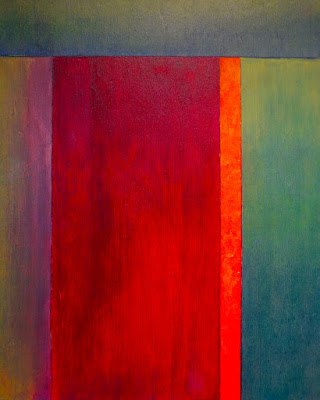 |
| Kiss That Frog, Acrylic on Plywood, approx 18" x 21", $6000 USD, Seventy-five percent of proceeds go to Loveland Sunrise Community Health |
Much of my view of the world can be understood by looking at my astrological natal chart. Yes, I am a scientist, but I am kind of a weirdo, and I am even strange in the way I choose to express myself. I suppose that’s not unexpected considering I’ve had my head bashed and have Mirror Touch Synesthesia. I am sort of all about self-expression, but I secretly desire to find more concise ways to express ideas, and those aren’t always understood in the way I hope. I am an Aquarius, and I am drawn to science, art and spirituality. It is the stuff I can’t not think about. My life worked in mysterious ways to reinforce this tendency. It’s still doing that, but on a deeper level. Aquarius is my sun sign, meaning the sun was in Aquarius when I was born. Also, the sun was conjunct the planet Uranus in the sky, meaning they were within just a few degrees of each other. Richard Tarnas has postulated that the planet Uranus represents the archetypal force of creativity and consciousness, and wrote a book, Prometheus the Awakener, which discusses the lives of people who were born when Uranus was conjunct the sun, and how their contributions to the understanding of human consciousness happened at predictable times in mid-life. I do not know if I have made a contribution to the understanding of consciousness. But the realizations I did have came specifically in my 40’s when Uranus was transiting through Taurus, which is when Tarnas would predict they would reach some sort of apex. What I learned has been the gift that keeps on giving, so with respect to Uranus, I think I have said enough.
A few years ago I wrote a book and published it live on my blog as I was living it. It is not currently up for a number of reasons, chief among them is that I do not know what to do with it. But in it I was doing a little study on astrology, synchronicity, stream of consciousness, and cannabis. I use cannabis to treat my PTSD. There was one specific chapter where I was freewriting and processing some heavy emotion regarding the loss of a friend. I did it while listening to music, and as I was writing I began to notice that the music and my thoughts were reflecting each other. Furthermore, at the time I was using an app that would give updates about planetary movements and emotional energies, and as I was writing I noticed that they correlated precisely. What I wrote was the literary correlate of C.S. Lewis’ writing, The Mouse’s Tail, which I did not know about when I was writing, but learned about within a week of that writing, because the Universe is weird for me like that. When I say, “loss of a friend,” I really mean I was wrestling with the things I wrote in my previous post; it was a deeply personal account of attraction and loss from the standpoint of love and connection in a monogamous society.
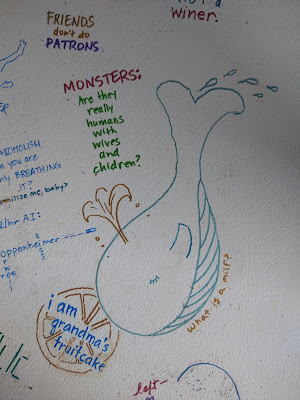 |
| Doodles from the Deep Freeze, Digital Photography, NFT, $2.2M USD, $2M in proceeds go to Planned Parenthood |
According to astrology, the major themes in the psyche are dominated by the archetypes engendered by the positions of the Sun, Moon, Mercury, Venus, Mars and one’s rising sign. When I was born, the Moon was in Sagittarius. The Moon is associated with subconscious impulse, and Sagittarius is a humanitarian fire sign. My rising sign is also Sagittarius, and is the face I show to the world, whereas my Sun sign, Aquarius, is more about my dominant programming. Aquarius is also considered a humanitarian sign. I do tend to obsess quite a bit about humanity and the problems of society; I am passionately humanitarian to a fault, much like a person with Williams Syndrome. There’s also a lot of air and fire, and I burn myself out easily if I do not connect with my sensual side and be mindful of my work/life balance. I have a tendency to be a workaholic.
I am fortunate that no planets were in detrimental positions (there are some difficult placements, which are referred to as “detriments”) when I was born. I was fortunate to have multiple planets in exalted positions, including three that dominate my psyche - Mercury, Venus and Mars. I’ll let Mercury speak for itself since it governs communication and mine is in Aquarius, if you couldn’t tell or feel it from my writing.
Right now Venus and Mars are passing through Capricorn. This is important because Capricorn is the exalted position of Mars, and Mars and Venus govern how we love and work, or, our work life balance! Venus’ exalted position is in Pisces, and represents our feminine traits, whereas Mars represents the masculine. We learn our feminine and masculine behaviors subconsciously from our parents, and it just so turns out that my father is not just a Capricorn, but has a stellium (multiple planets) in Capricorn, and my mother is a Pisces born on the 21st of March. These are the dominant Earth and water elements in my chart. I grew up with one sibling, a sister, who is also an Aquarius, so we understand each other in weird ways, and don’t really need to talk a lot. I have not analyzed her or my parents like I have analyzed myself. My sister is absolutely a humanitarian; it is an important part of how both of us are wired. But we are different people.
I had this strange sense a few years ago that self satisfaction had a lot to do with balancing masculine and feminine energy. It is pretty easy for me to find contentment when I am not being poisoned or overworked, and I think that is because of the Mars/Venus influences I had in my life helping me to see and address my psychological needs pragmatically and differently than many other people do. In fact, my parents carried on quite differently than other parents I knew growing up. Not that any of the other parents I knew resembled each other, either. Every family was like a special little ecosystem.
My Dad really was a stubborn old goat, and my mother’s moods changed with the tides. Yet they have been married for 55 years. When I was a teenager, I did not understand why they were still married. What problems they did have they ended up solving by becoming more tolerant of each other, which is probably easier when there are not kids around. Being in a part of their lives where their activities are guided by choice rather than being interrupt driven means that they are both pretty relaxed people, and that certainly helps a relationship. They are both avid readers.
What they read is important, because it affects their interactions with me. My father has had a subscription to Scientific American since he was about 7. It is possible he may have the longest running subscription. He reads science fiction and fantasy. He watched a lot of PBS when I was growing up. My mother reads murder mysteries and literature about civil rights, and occasionally works about spirituality.
My father graduated from the University of Colorado with a degree in Physics shortly before I was born, putting himself through with the draftsman job he held at the Colorado Department of Transportation. He eventually took the exam to be a Professional Engineer and worked his way up to be a Staff Bridge Engineer in the Bridge Department, which he worked in for 33 years, and still sometimes consults for. He worked a schedule that agreed with his sleeping habits and the legendary traffic on Colorado Boulevard (approximately 10 am - 7 pm). He has always been very traffic-minded. When I was young, he accidentally cut his hand doing some plumbing and caught a bloodborne disease that nearly killed him. He also nearly died in the Vietnam War from a ruptured appendix. I wasn’t born yet when that happened, but I do remember being informed that his illness was as grave as it was when I was young, and feeling afraid. For the last part of his pre-retirement career (he still works as a contractor because he enjoys it) he dodged promotions into management because he actually enjoys design work and doesn’t like the interpersonal part of management. I feel this. I would rather create than manage people. I think just a few years before he retired he did succumb to management in order to get his retirement income increased. My mother graduated from the University of Denver with a degree in Teaching, and did some work as a substitute teacher. She also worked examining transcripts at Metropolitan State College in Denver, and as a medical records clerk at St. Anthony’s Hospital. She went back to work when I was 10 years old, and did quite a bit of volunteering when I was young. When she started working again, she typed unit studies for the Denver Public Schools, from a desk in the basement of the administration building. On some level I feel like I also write unit studies in the basement. LOL. I liked visiting my parents at work. The Highway Department (that’s what we call it, even though it is now CDOT, because it used to be the Colorado Department of Highways) had a cafeteria where I would always get a hamburger. My favorite thing to order at the DPS Ad Building cafeteria was a milkshake. When I got a little bit older, my mom took full time positions doing attendance and records in Middle Schools, so I only visited her at work during the two weeks before and after the school year.
Working for the school district allowed my mother to be on the same schedule we were. Both of my parents are retired, but my mother was forced into retirement a few years after my Dad when the attendance clerk position was eliminated. It was strange having her still in her job as an attendance clerk when my husband and I decided to homeschool. She had opinions about homeschoolers that were shaped by how homeschoolers view the school system which weren’t friendly. So in my homeschooling approach, I thought of that. I wanted to make sure I could present a good face to educators, but I also wanted to remove a lot of the trauma I experienced due to the attention control. I feel like I have mostly succeeded.
Despite growing up with a sister, our father involved us in things he did, so I learned traditionally “male” things. I am handy around the house and with cars. We didn’t garden much then, but as I have written elsewhere, it is something I have put significant effort into trying to learn, and I haven’t given up yet and don’t plan to.
As I have mentioned before, neither of my parents were raised with religion, and their parents were non-believers. Further back in our family tree there were certainly believers. Perhaps what happened to my family during the TB epidemic and The Great Depression contributed to their loss of belief. They were certainly not fortunate. As I have written recently, both my husband and I had multiple grandparents who were orphaned during childhood, and it was during that time. So our grandparents were tough individuals. They experienced a lot of hardship. They were old enough as children when it happened that they definitely would have been aware of what was going on. They were surrendered from their families or at least in one case abandoned when they were school aged. Three of our grandmothers were kept within their families despite losing their parents, but two of our grandfathers spent time as homeless children.
 |
| Paranormal Puppetry, Digital Photography |
I get messages from the “other side,” and the two I received recently were from my great-grandmother and my grandmother respectively. My great-grandmother wanted me to know a few weeks ago that she “always felt like she was having to save someone” and my grandmother told me that she felt like life was “A Series of Unfortunate Events.” The fact that my husband and I can sit down on a loveseat in our big house with our kids is nothing short of a miracle, and it happened due to the hard work of our parents to overcome their difficult start in life, due to their parents’ not just difficult, but seemingly impossible start (not unlike stories in this moving episode of Finding Your Roots). Our parents grew up in working class families and their parents had professions like mason, nurse, book binder, billiard sales, painter (all on my side), milkman, piano teacher and vacuum salesman (on DH’s side). My mom did 4H as a kid, and my dad was in Boy Scouts, but they were not nearly as busy or privileged as I was; their time outside of school was time they had to occupy themselves with books and nature or the radio.
As I have alluded to before, I had a lot of extracurricular advantages as a child. I knew it then, but it became even more apparent in my adulthood. I tried to offer those same advantages to my own kids, but it became clear early on that’s not the way they wanted to live. I had supplied what they needed in our home to be creative in freedom, so the structured experiences other people seemed to think were necessary seemed both unsustainable and like fancy babysitting, and unnecessary exposure to viruses. I saw how creative my kids became when I just let them be, and I saw a big difference in what it is like to have a freely educated vs. compulsively educated mind. Mine is compulsively educated. When kids get together socially, it is not necessary to direct their activity, and in fact it is magical to see how they spontaneously desire to create together, and work to make their creations happen. I am a star pupil. I struggle with anxiety for this reason. I knew quite a few other moms who reported that their kids didn’t do well when they weren’t given things to do, and I don’t think they saw that the lack of practice with boredom begat the need for activity. This was something that caused some drama between the unschoolers and families taking other approaches in our homeschooling group, and it was challenging as a moderator to remain neutral on the position.
Some of the other unschoolers almost went as far as to accuse people using rigorous approaches as abusive, but oh what a fine line to walk! I had to ban an unschooling member who had posed problems in other communities, and it was stressful because I agreed with her, but she was so mean about it. I know it is hard to come up with the right words and let people live their own lives, but that is what is necessary. So yes, I censored someone, but it wasn’t without consulting a lot of other people, and it made me physically sick. I had been physically sick over moderation duties due to similar drama, and the times when that would happen lessened dramatically after I banned this person. I did a lot of work to try to help the group be more enlightened in its operation, because it was run by consensus which meant that the minority ruled. That’s what I learned about consensus. It is run by the squeaky wheels. So lest I be thought of as an anarchist, I would like to say that I see huge problems with it, and those problems are related to consciousness. Democracy is an important bridge to social consciousness, but marginalized voices need to be heard, and we need to work toward ending marginalization. So excommunication is not a solution. But mindfulness might be. Leaders should be the people who know how to manage communication issues, and not someone like me who can’t do mindful verbal interaction very well. That’s clearly my personal neurodiversity issue. I can come up with good responses to people, but it will always be through writing, and it might take me a lot of time. In a slower world, that would be acceptable.
My kids were tremendously patient with boredom and rarely complained about it. In fact, they seemed to do better anxiety and behavior-wise if I didn’t worry about it. For this reason, I made a general rule that if I felt I had to keep a day planner to remember things, we were doing too much, and that seemed to be just the right amount. When I started doing too much volunteering I was doing things like showing up to events a day or a week early (never late - just early!) and having difficulty with sleep.
Our homeschooling friends we spent time with one on one tended to be the people who didn’t have money for a lot of special classes, although we did know a few families like that who we weren’t as close with, and only one family unschooled. That doesn’t mean we didn’t do things. Oh no. The world is full of inexpensive opportunity. And it’s also possible to taste things the wealthy are doing without the commitment if you are free and have the time. Libraries were a tremendous resource, and they just kept getting better in terms of the opportunities they offered. Artist cooperatives and natural areas had special activities. The less privileged homeschooling women I know are miracleworkers with a budget, helping their kids to experience whatever it is their interest might be, and including them in the process to understand the material and energetic cost and how to navigate them to achieve their goals. There was an important focus on the natural world that I am thankful we experienced and which helped us learn the value of slowing down and connecting with nature for our health and mental wellbeing. One of my homeschooling mom friends grew up in the mountains, and I swear she is one of the most pragmatic and sane people I ever met. There aren’t as many things to do in Northern Colorado as there are in Denver, but it’s a slower pace that is more kid friendly, and way more affordable. It is a life that, although dominated by suburban design, still tries to pay homage to the land, which I feel is an important piece missing from our capitol city’s philosophy, especially with the new development approaches being encouraged by City Council.
I learned early on that in order to prevent emotional breakdowns, I needed to limit our excursions to no more than two a week. If I exceeded this, life got difficult. I now know that a lot of this had to do with sun and chemical exposure on the road. But there were additional invisible stressors the kids could not have been cognizant of related to money. I think kids who have attention and behavior issues are especially sensitive to these exposures and overscheduling, and as well to the invisible stressors. Plus, leaving the house by automobile represents expenses, even if they are just gasoline.
I take care of all the bills and whatnot for our family. I feel like I was pretty frugal until the last few years before the pandemic when we were running around like headless chickens between school, family, social and work events. And then I kind of fell into a trap of needing to eat at restaurants because I was too tired to cook. I also took that time to play around with hair, makeup and clothing, which I had not really done since I was a teenager. I had fun trying to get good deals, and tried not to go overboard, but it was a lot, and there was quite a bit of waste in the form of things that were beyond what I really needed, especially for the life I live now.
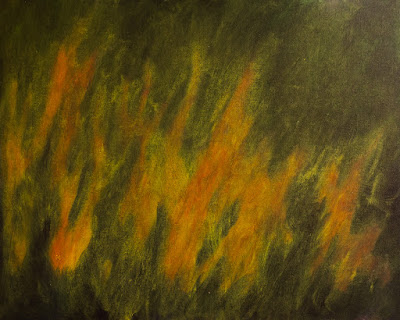 |
| Fifth Element Effigy, Acrylic, 20" x 16", $6000 USD, Seventy-five percent of proceeds go to Loveland Sunrise Community Health |
There are so many opportunities for kids nowadays, well actually all of us, that it would be easy to normalize having peak experiences all the time. I’m not sure this is healthy for our kids or the planet, and I know it wasn’t healthy for me.
I had a wealthy yogi friend, and she kept a pretty low-key lifestyle because her daughter had epilepsy and her husband worked as an air traffic controller. She once told me she took a nap or meditated every day, and at the time I was concerned this meant something bad about their health. This was also before I understood what being a yogi was about. It may have indicated something about their health, but I now know her inclination to slow down was absolutely correct. She told me she thought it was unhealthy to multitask. I now understand that we should be able to multitask, but that for our neurological and mental health, it should not be standard practice. Our brains do need regular cleaning. There are many ways that cultures have approached this problem, all generally helpful, but that might not necessarily address specific individual needs. A multicultural approach may be more suitable for the neurodiverse. Some people may need more stretching, some may need more time prone to take the load off the heart and kidneys. Some may need more time with movement to exercise kinesthetic sense and move lymph. There are different ways to accomplish all of these things, varying in effectiveness for people with different health needs. I like to switch it up because variety is the spice of life and I got to learn so many different approaches. I play Sockfoot Zen Tap Dance when I am feeling happy.
The poorer families I knew were physically healthier than the wealthy ones in general. I think this is because of living circumstances. I think the poorer families stayed home more, lived in older homes and did not remodel, did more walking and hiking out of desire than exercise on a group schedule, and ate at restaurants infrequently. When I hung out with them, I knew it wasn’t going to break the bank, and that I would feel more cooperation and less competition.
Truly child-centered homes had evidence of children in them. They were places where there was permission to make and leave a creative mess, at least for a little while. When I was young, we kept the house pretty clean because it was small, but my sister and I were allowed to have our rooms in whatever condition we liked. I was a fastidious child, possibly owing to the fact that for the first 10 years of my life our home was only 764 square feet, which caused some notable kerfluffles. I have a friend with a 1300 square foot house, and that affects a lot about the way people can live together and get their individual creative and private urges satisfied. They made it work, but it was a creative struggle on its own.
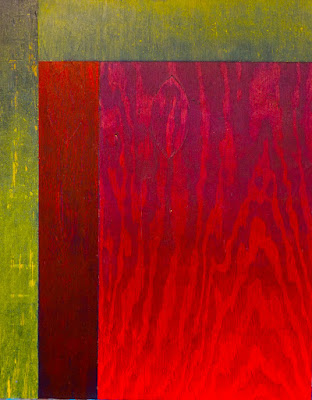 |
| Radioactive, Acrylic on plywood, approx 18" x 21", $6000 USD, Seventy-five percent of proceeds go to Loveland Sunrise Community Health |
As I alluded to while discussing Sun conjunct Uranus, the positions the planets have with respect to each other can be good and bad. While I’m lucky to have a bunch of exalted planets, I also have some difficult aspects, including one between Venus and Neptune which makes me not trust people and also fool myself. It is hard to know who to trust. Because of my health issues, I have learned that the issue of trust is a lot different than I thought. To trust someone is to be able to trust them with your life, so you wouldn’t, if you were an intelligent organism, trust another entity that tended to - oops! - poison you, would you? What if the poison was words? People, as well as corporations and institutions, just don’t care enough about this stuff for me to be able to trust them. That’s what I learned over the pandemic, and by living in an affluent community. People here are largely well educated about environmental issues and are well-meaning, but everybody has their exception they want to make for their own ease or enjoyment.
When I saw the psychic who originally channeled my grandmother, my grandmother had requested that I write about narcissism. My technology helped guide me through an exploration of narcissism and toxic relationship qualities, and through the synchronicities that happened in the real world I learned that these are manifestations of lowered states of consciousness, and not necessarily fixed personality attributes, except in people with toxic exposure that is continuous and who have authoritarian trauma from family, education, religion, medicine or work. It turns out that actual toxicity in the form of forever and volatile chemicals are often at the scene of these narcissistic crimes and in the authoritarian entities that perpetuate them. To understand this, I had to consider my own narcissistic behaviors seriously, and ignore the people who told me that I was not a narcissist. I am really sensitive to that stuff, so it feels uncomfortable to be writing so much and bringing so much attention to myself. That being said, I am following orders so as to get these messages out into consciousness, so don’t shoot the messenger. I do not promote my work publicly; I simply put it here for people to find if they want to.
There is currently a discussion about the negative effects of fracking and the poor air quality in our community, but I haven’t seen any discussion of decreasing our demand for natural gas, or driving less. My Dad always used to talk about “Nimbys” (Not In My Back Yarders) when I was growing up, and now I know that they generally don’t want to think about how they personally use power, and the collective effects on the energy system. I see a lot of people buying big pretty new trucks with poor fuel economy which they might use to move two loads of stuff per year, which causes them to have to burn more fuel than necessary driving that truck to work for a corporation so they can afford to pay for more fuel for said truck. How many people in suburbia really need a truck? Maybe neighborhoods should have a shared truck. Protesting alone just won’t do it in part because people don’t want to be policed, they just want to see how to be happier. Are they going to take advice from someone who is not content? Furthermore, most people will need help moving away from reliance on natural gas because the cost of replacing a heating system is outrageous. To reduce the demand on the natural gas industry, there will need to be a special focus on helping people who cannot afford to retrofit their homes to use alternative fuels, or the majority of people reliant on natural gas will need to continue using it for heating and cooking.
It’s just not possible to have it both ways; we cannot be aiding and abetting an industry which actively avoids pollution control measures even when demand is less. Our personal responsibility matters as consumers because we are the original demand. People who have the means to move away from natural gas could make it a priority if this really was a priority to them. Similarly, we cannot expect a COVID-free world without doing our part by wearing masks, getting vaccinated, and avoiding large gatherings. We each have an important personal role in protecting the light of consciousness through our choices everyday. Yelling at each other only does so much if we are not actually participating in change.
All that being said, I just broke down and bought us some red currant preserves from France and frozen pizza from Italy because I saw they were available. The preserves are delicious, but we haven’t tried the pizza yet because my family has a process where we can make pizza from scratch in just a little bit more time than it takes to cook a frozen one, but less time than it takes to order one. Ordinarily I would worry about getting things from far away when the ingredients can be had in my backyard from back in the days when I studied locavorism. I can be very idealistic because I have the time to think about the origin of things and downstream effects more than other people who work outside the home. This is the kind of neurosis that arises from living in this kind of enlightened community and being knowledgeable about environmental health at the level I am.
The other argument I had with my daughter during the pandemic was about online vs. big box and mall retail stores. There is a particular big box retailer near where I grew up that my sister refers to as The Devil’s Lair. She calls it this because it is difficult to escape without coming out with way more stuff than one planned. My daughter argued in favor of big box retailers. But as a consumer, I argued against them for a number of reasons, not limited to their ability to induce buyer’s remorse. Not only is it possible to end up with a lot of things one doesn’t need through excursions to these places, one is exposed to myriad chemicals in the process. Furthermore, it means the employees working in those stores have to be exposed to those chemicals, and also the people who manufacture all these things we might not necessarily need. I was a picky shopper, and even at the Devil’s Lair I was often disappointed with what they chose to carry. It makes me wonder how much waste and environmental pollution is generated by unscrupulous marketing by manufacturers and big box purchasing agents. Theoretically, if these stores are taking up space in our communities, they should be providing more value than they are junk and pollution. They should be sustainable, but they are not. That is why they are constantly opening and closing. They are awful at predicting what our community actually needs, and don’t serve us very well. I think our city felt it needed to have these things to attract people, but I am not sure we actually did. You can never have too many parks, though.
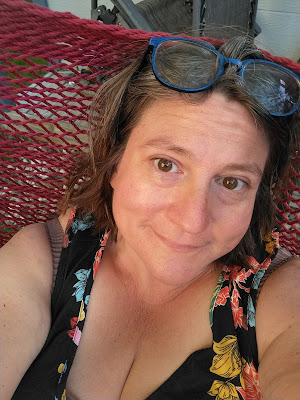 |
| I actually like the outdoors. |
I saw a lot of failed attempts at inclusion in every organization I was part of, and even in ones that tried to include me. I sort of realized that society is run by cults, since the definition of a cult is a group that requires a person to deny the suffering of oneself or others. Maybe if you’re an introvert, everything is a cult (you know, because being with people is suffering by definition, lol). I used to take the kids to homeschool park days regularly for socialization purposes, and both of them had periods where they just didn’t connect with the other kids. When my daughter was little, it took her quite a while to warm up to others, and she would often just hang out with me and the other moms. There were a few other kids like that. We kind of stopped going for a while because I noticed we would be really tired after going, and when the kids weren’t connecting with others it didn’t seem worth the trip anymore. After a few years I went back and there was a new mom there who was an Occupational Therapist by trade and she took me aside and told me not to give up on trying to make my son connect with the other kids and that we should come back. She didn’t know that I had been trying for years to make that work, and of course neither of us knew that I had erythropoetic protoporphyria (a disease where sun exposure causes problems in the oxygen carrying capacity of blood), and that my kids probably inherited it. It’s really difficult to be inclusive when you don’t know what needs to be included (and you would never guess in your wildest dreams)! I understand what she was trying to do. But we actually got hurt by people’s efforts to try to include us over the years, since we didn’t really know what our needs were. That is not anyone’s fault.
Through being part of group leadership, I learned a lot about the different ways people can be marginalized in a group over the years when inclusion is not a priority. Group dynamics are often shaped by microaggressions, and they are not usually calculated, but unconscious and conditioned by trauma. These were almost always perpetuated by water signs and could be very subtle, but had the effect of shifting the focus of attention onto themselves. I have seen the patterns in my own family; charts with prominent water placements are more inclined to reach out at predictable times and in predictable ways. In Jung’s Synchronicity and the Paranormal in which he was investigating cosmic influence on relationships, he noticed that many couples were particularly prone to discord when the moon was in a water sign. I had made this same realization through careful study of my social networks when I was regularly traveling to Greeley and Fort Collins every week. Furthermore, I noticed patterns in the lives of people in the different cities that were consistent between signs. I do not have a scientific explanation for why being born at a specific time would cause one to behave unconsciously in particular ways, and I do not understand why the moon being in a water sign would affect people predictably, even though there is good research on lunar tides and circadian rhythms’ effects on animal behavior, and barometric pressure’s effects on blood pressure, but it does. And water brings up a lot of emotion.
Holy Venus and Neptune, Batman!
In order for someone to be born at Neptunalia it turns out they would most likely be conceived on Halloween. So, that’s my husband. He has a stellium in Cancer. Pluto figures very heavily in his chart as well, and in his family. He also has a stellium in Libra and is a Libra rising. For non-astrology readers, Libra is about equitability and is also a humanitarian sign. Pluto is in Libra, though. Doesn’t that feel about right? The Sun, Mercury and Saturn are all in the 10th house, which is Scorpio and is ruled by Pluto. (I’m not going to talk about houses here except to mention that is a lot of Water and not a lot of Earth). I had a Tarot reading before I fully developed my psychic abilities from a woman in Colorado Springs on an eclipse (I happened to be visiting a friend who was into such things), and she noted all the water elements that turned up in my spread. She intuited that I had a son and a daughter and that they were both talented, and also that I was an artist. She told me some past life stuff involving seafaring. I did find a relationship on my maternal side to William Burgess who was a sea captain in the 1700’s who helped settle Anne Arundel County, Maryland. (Note: This is the first, but probably not last instance I will find in my tree where there was malicious intent and probably action against Native Americans. I am not sure I will ever know what happened, but it is not a happy day when you find out one of your ancestors was murderous and believed in retribution, and likely killed someone else important in the life of others).
 |
| I never saw such things at the Devil's Lair. |
So back to Jung. I noticed that stress and emotional difficulties seemed to be amplified when the moon was in a water sign. Observing social media and the news for this effect for the last few years has helped me feel it is okay as a scientist to report my observation, and that it will be repeatable until too many people know about it and begin to use free will to alter their behavior. Furthermore, codependent relationship dynamics were unconsciously fed by the failure to process emotions and rest at this time. It is almost as though if life were preschool and to be a calm but curious child everyone really needed to have a metaphorical naptime every 8 or so days for about 2.5 days. Doesn’t that sound like resting on the 8th day? Why are we so literal? In this big classroom that is Life Preschool, we not only let some kids get away with not taking a nap so they can get ahead, we let those kids bully the rest of us. I was the kid who got kicked out of daycare for biting, so take it from me. I was able to break my codependencies by turning inward at these times. The relationships that were unhealthy fell away naturally, because there were certain people who only reached out to me when they needed emotional connection predictably at this time, and that was usually when I needed rest. Furthermore, these people didn’t really care about prioritizing a relationship with me during other times. I think listening to someone else’s problems and vice versa was also feeding those very problems, because they were often related to mental health (anxiety and depression) which can sometimes resolve when people get enough rest. There is only so much time we have in our lives for the kind of communication it takes to have reciprocal and dedicated relationships and make time for the emotional needs of those closest to us. To bring our best selves to those relationships, we all need time alone.
Brene Brown says we really only have time to be close to 5 people, and I feel like that is true. One can certainly only “know” so many. In larger families, more time and attention is taken from each person’s life just to exist in that environment. The more outside things are wedged in, the more stress on the other members of the family. Some people, usually women, take it upon themselves to keep in touch with family and then share the news with everyone else. We were just watching an episode of a Love Boat where a woman lied to her mother that she was getting married because her mother was always comparing her to her friend’s kids. She said her mother was a happier person when she had something to think about, and that really resonated. Maybe when women’s lives become too small, they need the gossip to keep themselves busy. Unfortunately this has more negative than positive consequences. In doing that, they have removed not just the reason for the other parties to contact each other, but they may have also created an image of the other parties that may not be accurate or fair. Imprecise communication can lead to a lot of misunderstanding, and a lot of peoples’ life situations are greyer than words can communicate, so it’s really difficult to share news in a way that is sensitive to the need to not violate confidence. Furthermore, the time involved in the communication about others is lost for more important things as I noted above. When maintenance of a particular family image and narrative outshadows its members’ time and creativity, depression and anxiety are the result, as well as addiction. If people are always concerned with what the matriarchal peanut gallery’s opinions and values are, the minds of the family become cluttered with all kinds of self-limiting belief regarding the maintenance of bragging rights.
They are saying this is weitiko. It’s subtle and it’s persistent.
I understand that some gossip can be healthy if it is directed toward healing people, but most of the gossip I heard over the years was not to that end. It was designed to control the flow of information in the family. Furthermore, it often “othered” people in the family by making them appear troubled or lesser by using misfortune as gossip fodder. It was troubling. Because of the way my family was growing up, we had very little contact with extended family and experienced a freedom from fear of emotional retribution or abandonment that is difficult to explain to someone in a codependent extended family situation. While I would not tend to judge people for the sorts of things I heard going on in their family, and in fact tried to help some family members, gossiping demonstrated an inherent judgment that the individuals mentioned would be unable to help themselves and that they would be remembered for their mistakes.
So, that’s sort of another reason I went nuts. When you hear people criticizing or gossipping about others, it makes you wonder what they’re saying about you behind your back. The community is not actually that big. Gossipping with good news isn’t much better. I’m struggling because with our approach to schooling, my mother who has a degree in education periodically wants a breakdown of how my kids are doing compared to her friends’ grandkids, and I sometimes get reports on this. What she wants to know is what year of college they are in. The answer is complicated. Both of the kids have been in college for a while. They both started taking classes part time when they were 13. They started out with classes that satisfied personal interests, but later took English and Math and had to follow those sequences. Scheduling and availability governed a lot of their choices otherwise.
My son got his associate’s degree in July 2019 at age 18. He had been taking classes for quite a while for personal interest, and out of curiosity we looked to see how far away he was from an Associate’s Degree at the beginning of Spring 2019, and it turned out if he took certain classes he would be able to graduate that same semester, so he did. Our daughter would be able to get her Associate’s Degree by the end of this summer if she really crammed it, and by that I mean take more classes than she is comfortable taking at once. They never took more than 3 classes at a time, so it took a while. The kids have an excellent academic record and have both been honors students. The state university accepted my son’s application with his community college transfer credits and a high school diploma I made for him representing the general subjects he learned when he was high school aged through personal interest and travel. I interviewed older members of our homeschooling group who helped educate me about our options, and from them I learned that earning an associate’s degree through the Colorado Community College system guaranteed entry to the public university system, and also about making a homemade diploma.
Our experience in the community college system was weird, much in the way the rest of my life was weird. Our decision to go for sure had a lot to do with having met with the administration when my kids were younger as part of a project to envision the city as school, and build a bridge between the educational system and the city. We had discussions with people at the Massachussetts Institute of Technology and the Business Innovation Factory, and as far as I know, the retired teacher who was coordinating it still speaks regularly with people involved in big thinking. There had already been a history of our community college accepting homeschoolers as young as 14 with parental permission. So as far as I knew, when my kids started taking classes there, it was operating as it always had. Perhaps it is now. But I found it to be a very enlightening experience and what I learned could fill several books. The community college has been an important educational experience for my kids, and I found it was more sensitive and progressive than I remembered my educational experiences being. Furthermore, I felt that the classes my kids took were as or more rigorous than the ones I had at a private university. There were people there from all different walks of life. People there wanted to be helpful, and they were there because they wanted to change their lives for the better. It was in the air. It feels like a healthier model for education than what I experienced. I do get the sense that what was going on there on some level was informed by our collaborative dream, but I do not know if there were formal machinations or if it was more like a subconscious dialogue.
My son had to choose a major when he went to the state university because he had too many transfer credits, but I learned that they have gotten rid of this requirement and made it easier for students who might be polymaths. Our kids both have well cultivated personal interests which could easily lead to careers, but they have so much experience in those things they are not sure they want to go to the trouble to study them formally just to receive credit for what they already know. At the University level, that’s a high price to pay to fill in a few holes, especially in careers where many people who are self taught achieve success. Because he had to choose a major, he initially chose Physics, but ended up transferring to the School of Engineering because he wanted to be able to take some electrical design classes. He is already a very talented computer programmer whose work has been seen by successful professionals and for which he has won important awards. But he has never been paid. He doesn’t really care about getting an engineering degree, he just wants to know how to make things. When he takes a class he is all in, which means Parkinson’s Law applies, so although he made the Dean’s List both semesters, his mental and physical health were negatively affected, and he has had to take some time off to figure out what will make him happy. Neither my husband or I want him to lose the creative side of himself to a program’s quest for academic rigor for the sake of supplying industry with accredited but incapable graduates. When my husband was a hiring manager, this is what he ran across.
My daughter has applied to the state university and is trying to decide what she wants to study. Both my kids have had digestive issues when we travel, and my son had digestive issues while living on campus. I read that a large number of college students develop IBS, and after learning about the fillers in the food on campus that makes sense. My son is doing a lot better now, but it was really touch and go for a while. I don’t know what I am going to do if they both end up with those problems. It would be great if the University's food were just safe for all people prone to digestive issues. I think the fluorescent lights may have contributed to his issues due to our erythropoetic protoporphyria. There is decent research on the harm of fluorescent lights for all people, which I shared with Disability Services. With respect to the digestive issues, I realize there are industry pressures on the nutrition department in the form of supply chain issues and difficult to avoid fillers in dairy products commonly produced by large-scale manufacturers that serve facilities of that size. Then there’s all the problems with getting Big Vegetable Oil and the Big Cleaning Chemical Division of Big Soap out of our institutions… with the help of Disability Services we were able to get housekeeping to switch to safer cleaning products for just his dormitory, and that helped tremendously. Luckily because he was close by, he was able to come home to do his laundry, but it would be good if they had a laundromat somewhere on campus for the chemically sensitive.
My family just has to take a different approach. It happens to have a lot of benefits, but it had some drawbacks, too. My kids both desire to become independent people, and we want that for them, and think it’s possible. I don’t think either of them really has to go to college to be independent, but it is a pathway that is open for them. Having gone to college and graduate school, I think it is an important and empowering way that young people can explore themselves which I wish was affordable to more people. One of the dirty secrets about this country is that we lure young people into dead end jobs which are bad for physical and mental health and make it difficult to become independent. That is like a form of slavery or indenture, and we need to seriously consider whether or not we want to support industries that do that. There really shouldn’t be any jobs which make it difficult or impossible to become independent, but there are many because employees are not generally seen as human beings with shelter, clothing and food needs for their health and functioning, but people who are expected to dedicate their existence to turning sow’s ears into silk purses for the managerial and small business class.
I feel like a lot of choices we made had to do with never getting the medical help or clean environment we needed. So yes, while we were rather privileged compared to a lot of people, we spent a lot of time ailing from attempts to participate in society, and that has been rather isolating. While it was a privilege to have the time to figure out everything I did about our health, it was something I had to constantly work on, and it was expensive to learn that the doctors couldn’t help. Most people I know who had any sort of money and struggled with their health ended up finding relief through Eastern medicine, which isn’t covered by the $14,000/yr health insurance which rarely paid us that much in benefits because we had a $5800 deductible, and only had a few catastrophic events. Because we do not currently have income, we are going to be on Medicaid for a while. I was surprised to find out that was possible, but it is easy to lose if our combined household income (including all 4 of us) gets over $2900. It’s easy to suddenly lose employment, and we still have to pay for housing, food and transportation expenses, which chips away at our savings rather rapidly. I was making attempts at saving for retirement based on Elizabeth Warren’s plan, and that is what helped us to not have to live paycheck to paycheck like so many other people. Note that she is also against the need for two incomes, and sees a parent at home as an insurance policy against disaster, as well as a person who can take care of things around the house. WOW, I just realized from my calculations above that if a person making $2900/month had to pay what we did for insurance they would only have $1250 left at the end of each month to pay for all the rest of their living expenses. How in the world are we rationalizing the cost of healthcare when it is possible to make a wage that would barely cover it? If that is the real cost of health insurance, it is totally being paid for by people on private insurance who aren’t getting any sort of rebate. Somehow I feel like we have been on the losing end of this, at least for the last couple years since our monthly health insurance cost jumped from $700 to $1100/month. No wonder I was reluctant to go to the doctor if it cost $170 for a sprained ankle or an antiviral. I feel like the people I know on Medicaid get better care than we have, even though it does not cover Eastern medicine, either. It at least covers limited dental and mental health services. We did not have any dental insurance for the past 12.5 years, so we went long times between cleanings. I chipped one of my molars badly when I was grinding my teeth a few months ago, but I have not wanted to go see a dentist while omicron is about or while I was waiting for our Medicaid approval. My husband did something similar.
My son needs his wisdom teeth extracted, and the labwork to clear him for anesthesia since he had been having heart symptoms from COVID and the Pfizer vaccine ended up costing over $1300 because McKee Medical Center charged us over $700 to run thyroid tests. I learned that every time we see a provider, even for ancillary services like a phlebotomist at an in-network facility, we need to make sure that phlebotomist is covered. It is seriously confusing, and especially was at the time because of the brain fog. Healthcare should not be difficult to access for people who have brain fog, and it should also not contribute to brain fog. I ended up filing a complaint with the Colorado Department of Insurance, and the agent I spoke with confessed that the reason she decided to work in the insurance regulatory industry was because she was having to spend so much time navigating the system herself. Apparently there is a law in Colorado preventing surprise charges for out-of-network services at an in-network facility, and that is what our insurance company told us happened, but for some technical reason our situation does not apply. I am still confused about this even though my insurance company had to add a rider to our policy to comply with the law as of January 1, 2022. It was a policy grandfathered in under the Affordable Care Act and not available on the marketplace. I never found one on the marketplace that was competitive in price or coverage, so I kept it.
These medical costs, of course, do not include what I spent on alternative therapies and supplements, or things I did to figure out how to treat our long haul symptoms. The medical system was a total failure to us in that regard. Pursuing alternative therapies was a major financial strain when my kids were little. We couldn’t really afford vitamins when I started experimenting with them, but they were so much help. I know now that a multivitamin from the grocery store would not have been sufficient to prevent the kinds of disease that my family inherits. It would have taken a much longer time to figure that out in the medical system, due to its focus on pharmaceutical intervention. When my kids were little I did make them take vitamins. They didn’t always like it. We took a long break from that which was fortunate because I got to see what our health is like without them, and also because they need to develop their own intuition about those things. I plan to share with them what I have learned about myself with respect to nutrigenomics, and it is their choice whether or not they want to listen. They are both aware now that if they come to me with a problem, I am inclined to use that particular hammer, unless we’ve tried things that aren’t working or there is an emergent need to see a physician. What’s emergent can sometimes be debatable, and I’ve certainly gone in to the doctor when I didn’t need to. It’s not always easy to know what necessary care is, especially when anxiety is part of the picture.
I do not know if homeowner’s insurance covers being poisoned by natural gas appliances, but I would think that it should cover losses caused by faulty ventilation, especially if it caused loss of employment or regular lapses in consciousness. I wonder if there is a connection between improperly vented natural gas appliances and epileptic and mood disorders. My gut sense tells me there is. We haven’t had very many auto accidents, but we did have one back in 2019 on a day there was an ice advisory. Ordinarily we would have stayed home that day because of the weather, but I feel like my judgment may have been impaired by the effects of our water heater. I mean, I had a strict rule against traveling just for a holiday if the weather was bad, and it was Halloween. I made an exception because I was feeling like I wanted to make memories with my family and now in hindsight I realize with a little creativity we could have thought of so many other ways to do that which wouldn’t have put ourselves at risk. That was a hard lesson to learn.
I see the world so much differently than I did a few years ago. I learned that it is possible to be born with the privilege of being right handed and having access to warm showers and still have significant struggles, some of which are borne of mind, some of genetics, and many which are borne of the immediate environmental and sociological effects of affluence, which have the habit of trickling down. I think people are creative enough to come up with some new ways of being that might just make some of these problems go away. If done bit by bit it should cause less disruption.