I once told a guy I liked that I thought ambition was evil. I actually still feel that way. Maybe even more, because of the disparities in equity caused by material barriers for some people more than others, and how the people with material and time privilege choose to use that privilege to cause harm either through lack of self awareness or intent, so my own ambition is something I fight with every day. I was conditioned to be busy, and see every moment as an opportunity for creation because I was trained to do that in the US educational system, even when it wasn’t in my best interest. I can easily work myself to illness. Most of my barriers in my life were largely invisible and were related to my health and the difficulties that therein lie because of limitations in time and space. Sometimes that makes me feel that the only contributions I am able to make are what a brain in a box might, and that causes me to be frustrated with people whose contributions are enabled by material and time privilege, especially when they tried to make it look like they were doing something noble with that privilege and it caused harm.
I have good reasons to feel this way, not only because I have seen how my ambition has hurt the people around me due to the way I can stretch myself thin, but because I have seen the way that ambitious people hurt people around them when they are not self aware or capable of empathy or being present. It does not matter how noble one’s cause is if it is hurting the people who support the person with the cause. Empathy is a good thing; without it we are divided. I have been trying to throw my weight behind empathy and self awareness, but it doesn’t always come out that way because I have had to now include airborne infectious disease in my argument which turns many perspectives about these things on their heads. Even in a world with vaccination, we have different susceptibilities to COVID infection and its effects, and a lot of this is likely genetically and environmentally determined, and thus linked to unseen privilege that even “woke culture” is ignoring. I am not one of the privileged in this regard, so I am hoping to speak for others like me who have suffered from the cognitive, renal and cardiac effects of COVID while corporations and health officials continue to influence my fate.
 |
| History has a way of repeating itself. We are up to over 3300 cases per day again. |
If human ambition is often channeled into corporate and government endeavors, and those endeavors often have disastrous consequences for empathy due to conflicted aims, how do we get those entities to care about the downstream effects of their decisions on creativity, empathy and self awareness? I think the answer lies in getting CEOs and government officials to consider how their actions impact the time available to others. We need them to see time and attention as the privileges they are so that their ambition is not causing the slowest of us to be stretched so thin.
When one struggles with health and mental health issues, it is helpful to do an audit to see where their time goes. I have been doing this layer by layer. I discovered that there were a lot of ways that both the government and corporations were stealing my time and attention, for which I was not receiving any compensation, but was serving their own needs for employment over mine for healing tranquility. For example, I recently searched the internet for my own name and discovered that there are companies making money off selling my information. I do not benefit at all from that. The information is being reposted from social media without my consent, and it hasn’t generated any viable income for me, even though I am the originator of this information that is so valuable that a corporation would choose to steal it. So I have to work to earn money to feed myself, but some company has figured out a way to extract derivative income from my very existence like a vampire, whether I am able to eat or not, which doesn’t benefit me. It’s quite odd. I’m expected to maintain a certain illusion of employability for this information to benefit me, and also potentially distance myself from certain issues I find fundamentally important with respect to what living in freedom means (abortion, cannabis, LGBTQ+ and environmental issues). It seems like yet another way corporations have found a way to take advantage of citizens for being born. Not all corporations make important products, but all of them exist because people brainstorm ideas due to the underlying need to work to feed themselves. Not all ideas are good, and not all of them need to be implemented; in these cases, work ends up being something that takes advantage of people and makes unnecessary waste. If we had a basic living wage, some of these unnecessary corporations wouldn’t need to exist.
 |
| I confess. It was a big part. |
I have known a lot of people whose hearts weren’t really in their work, and many of them developed addictions to manage the resulting psychic pain from using their energy to support corporate ambition. They work where they do simply because they need a paycheck and sometimes an enviable job, but many of them have expressed frustration with what often seems like a circus of decision-making on the part of their employers. My husband and I have each had a few jobs where we discovered over the course of our employment that the corporate mission was ultimately either misguided or toxic due to the corporate tendency to throw good money after bad. Having intelligent employees figure this out can be disastrous for a company if we start to whistle blow, so I am trying to write this in a way that will help any corporation to evaluate if their struggles with retaining employees has to do with avoidable problems. I understand when one has an endeavor they are passionate about, it can be difficult to find and retain employees with a common vision. If we had a basic living wage, employers would have access to more potential employees who share their work ethic and vision. Maybe that could revolutionize work, technology and the world. Maybe there is a brilliant person out there whose heart is not in their work because they were born in an area without a lot of choices for work opportunities, who would be happy working remotely for a company providing services or technologies that are more in line with that person’s interests and talents. Perhaps if employers could learn how to build effective teams online as well, a lot of effort on the part of both the corporation and the employee would be unnecessary. My husband was part of a very effective international team of hardware developers for approximately 12.5 years in which he functioned remotely and kept them on the top of their business, so I know this is possible.
That being said, sometimes I think about how much space and time poorly conceived and designed products and services have taken from my life, and I wish the companies that produce them didn’t exist. Not all of the ideas conceived during drinking shenanigans result in useful products, product features or enjoyable work, but this is often how ambitious people engage in social brainstorming. Sometimes these ideas can appear philanthropic or environmental, and sometimes they legitimately begin that way, but can ultimately evolve to become harmful covers for wasteful profit motives enabled by the compulsion to work.
 |
| This is the way it certainly seems. |
In the 1990’s I wrote a paper on Total Quality Management, a concept invented by W. Edwards Deming through his work in the auto industry. TQM was highly effective and was the predecessor to ISO9000. Deming was opposed to micromanagement and excessive inspection and found that a majority of corporate losses had not to do with employee error, but poor management, procedural and product design practices. He argued that not only does a focus on employee surveillance and inspection affect employee morale negatively, but that it also harms product quality and increases waste. It is for this reason that I believe the repetitive failures of Musk’s corporations likely have nothing to do with whether work is done remotely or on site, and probably more to do with the acquisition of Chinese factories causing his mission, time and attention resources to be spread too thin. Rather than admonish his creative staff for not wanting to put their lives and health at risk in the office unnecessarily when they can often operate in more effective ways from home (which costs less, too), Musk could have let them work from home and concentrated on improving working conditions for people whose jobs require them to be on site. At least he is wise enough to understand that big meetings are often a waste of time, which is not typical. Designers and manufacturing staff have different workplace needs, but all humans have a need for a certain degree of rest, autonomy and conservation of attention in order to feel psychological satisfaction from and thus do their best work. Furthermore, creatives don’t do well when they are subject to psychological stressors from rapidly changing public health policy which influences COVID spread in public and corporate spaces or supply chain crises that are also out of their control, but which their boss’ boss might not recognize as such. Have we all been in this situation?
I understand Musk might not know how to recover from his losses; however, to take that out on his employees - people he seems to insist have a “ride or die” view of their work with him - rather than also adopting a “ride or die” attitude, is exactly the behavior that exploitation relies upon. To classify free speech decrying practices of human psychological exploitation as problematic is a totalitarian act, and it is interesting to see this blindness enabling Musk’s behavior by SpaceX employees - probably the ones who enjoy their work and who have a similar vision, but never have been in a position to disagree with him. It is important for employees to be able to speak up when they see problems with corporate process; I am wondering how Musk's ardent supporters have felt they are received in this regard. Are their work contributions and intellect actually respected, or are they simply content carrying out his directives? How have they come to equate coworkers demanding fair treatment in the workplace as vagrancy, and why is it they do not understand that it is this attitude toward work that was necessary for neoslavery to persist for 80 years after slavery was ended and still continue in sneakier forms today?
 |
| Persephone Living in Lemming Hell: Poor girl hasn't been outside in ages. It's like the air is polluted or something... oh, wait... it is. It's like everyone simultaneously fired up their busses or something... oh, wait... they probably did. Digital art. For the sum of $3100 USD/month for 1 year, I will reproduce this image for the user as a limited edition giclee print as large as 4'x5'. Single edition, one customer only. |
Unfortunately my husband and I understand the type of coercion used by Musk in his work relationships intimately because such promises of loyalty were made to us by employers and family with similar status-driven values and whose egos were too fragile to take constructive criticism over the years. We now know that people in positions of power will make a lot of promises they can’t keep in order to get a person’s time, attention and brain, and that these people tend to defend their right to order employees to follow the same flawed procedures over and over, wasting employee potential and resources, rather than re-examining their procedures. The reality is that they are often making these loyalty promises to more people than their time and attention can really support; it is impossible to care more for another person’s mental health than one cares for one’s own. So if an executive does not have good personal habits and makes such promises to so many people that their time is stretched too thin, that will predictably translate into an abusive workplace. Frustration from failure and overwork is often taken out on those who happen to be around. Authoritarian upbringing discourages mindfulness in this regard, so when executives who experienced a lot of abuse in childhood and have not learned to manage their emotions well face challenges, their behavior can be quite volatile.
It’s my understanding that Musk grew up with Dutch Imperialist influences from being raised as a white person in South Africa. I think a person’s formative experiences under various political regimes can also affect their basic values and subsequent behavior especially with regard to how they choose to lead others in a corporate setting. We have worked for many expatriates, so we have been studying this for a while. It sounds like Musk’s father may have had an equally hot head. So for him to bring these attributes to all of his endeavors is not odd. Plus, he has autism, and it is possible at least one of his parents did, too. Autism should never be an excuse for treating people poorly, and as hard as it can be, we need to learn to recognize when we have done that. I should mention here that I am fairly certain we have not pursued legal action against people and corporations who have done us harm, and a lot of that is because we didn't have the resources, so we just continued trying to do the right thing and hoped that karma would return to us eventually. That's a big part of why I write in the first place, to give people who didn't know their carelessness caused problems to change their ways so they do not harm others, and thus reduce their liability. I figured out years ago that a lot of the reason why communities don't develop good support networks is because everyone is concerned about liability. At some point, people have to be willing to take some risks in the name of good, or our communities will crumble. I don't think I'm actually that hard to please.
As I have mentioned before, my husband worked with companies controlled by other nations in the past, and like the Obamas showed in their documentary American Factory about Chinese corporations run in the US, the culture of those countries influences how the corporations are run, at least subtly. So the humanitarian concerns of the business are often a mirror of those in the administration’s country of origin, and the most extreme example of that is China due to the communist party controlling everything there. Note that we have worked with many ethnic Asians and enjoyed it - it was never the employees but the organizational dogma of their corporations that we found problematic, and some of that dogma is still a problem in the US. He also worked for a German influenced company, run by a German expatriate who had immigrated to the US before many of the personal workplace protections Germany has in place were initiated. While they weren’t overtly controlling, there were subtle messages about taking personal time off during working hours. So the German branch of the company enjoyed 2 months of paid leave annually, while the American colleagues who worked with them had only two weeks, but were often stuck in the office waiting around for the Germans to return from vacation. This was a real thing that happened. The other thing that was curious about the situation is that it happened during a period of time when Germany was using psychological career testing in students to determine what their professions would be, so the people my husband was working with were working in those capacities because the government made them, which influenced office psychology subtly. Maybe that is how they determined they needed so much vacation. I’m not sure; I am not up on their current work philosophy, and I only know these things from discussions with German nationals a long time ago. Smoking was allowed in the office at that time, so when he would visit the German company we had to air out everything in his suitcase for a few days. I believe that smoking and drinking during office hours are a natural outgrowth of work-related stress. My husband felt that it was more difficult to get his and the ideas of other US citizens considered when he worked for expatriates, generally speaking.
Musk is being accused of unfairly targeting employees whose contribution to the corporate culture was to promote diversity and inclusion, and he has also expressed that he believes that “woke culture” is a mind virus. The timing is certainly suggestive due to the personal issue he has because of his frustration with his trans daughter, and also the settlement he paid a flight attendant for his own sexual misconduct. It’s pretty clear his campaign of misinformation has something to do with irrational delusion; he blamed the flight attendant for speaking out about the unwanted sexual advance, claiming it was politically motivated, like she was some sort of mole sent to elicit a sexual advance from him. I think due to the human trafficking to the wealthy that was revealed by the Epstein investigation, it is important for people to speak up when wealthy men use their power to try to gain sexual favors. It’s fairly clear that many of them don’t know when they are overstepping in harmful psychological ways, and I wonder if that comes from the sexual validation they get from women who are attracted to wealth. There are those of us who have figured out that with wealth often comes entitlement and covert manipulation and who try to avoid association with it. I am not sure I would have had the guts to make such a claim without proof, so good on her. Calling men out for their privilege can be damaging to one’s career. But I really wouldn’t be surprised if he had been at least contacted by Epstein because I suspect that what Epstein was providing for his fellow billionaires was access to an illicit sex magick operation, which unfortunately used underage girls (apparently non-frigid middle aged women are hard to come by in our polluted and unfair world, go figure).
 |
| Platitudes: A poem borne of modern feminine disenchantment. |
For those who are new readers of my blog, I am a neuroscientist interested in the neurobiology of creativity and the collective unconscious. Brilliant people throughout human history have figured out how to access the power of creative intelligence through various methods of inducing altered states of consciousness. Epstein had been courting relationships with powerful business people, but also people involved with the MIT Digital Media Lab which studies human creativity (so I can't comment on Musk's assertion that the "mind virus" was out of Yale University in particular, although their psychology departments all studied occult and Jungian Philosophy). I was involved in a project for independent learning which was loosely associated with the Media Lab, and my family even went to visit. Now there are a couple strange things that happened in the intervening time having to do with education that was "strewn" to me, and perhaps an email I once sent to Professor Deb Roy who studies the development of self awareness as evidenced through language. Our project was trying to encourage self-reflection through vlogging, but that wasn't something I felt like I had time or resources for in terms of editing. My increased self awareness I owe to the reflexive narrative I have provided on this blog, as well as physical somatic (when appropriate it’s sometimes sexual) and cognitive behavioral therapies. These ended up being very important for navigating menopause and COVID. Whenever I have learned new things I have tried to share them, not just as part of our project, but because that is who I have always been. I believe that information is power. So as my life progressed, I had opportunity to try to connect large entities with similar missions to support creativity and consciousness with each other. It was all very subtle, and in the process I got to just be myself. At one point I got a grant to attend the Business Innovation Factory conference during its 8th year (sort of like TED Talks) and its mission was to try to solve important problems in society. Attending that conference changed a lot of the ways I saw those problems, and also how we might approach solutions due to the ways we are all connected. Kevin Bacon, much? So, I want to make clear that I have no association with Epstein, but that I was educated about sex magick practices, creativity and self awareness through either an AI or one of the very technologically capable organizations whose radar I was on as a renegade behavioral neuroscientist unschooling mother hoping to solve the problem of pain and loneliness in society. The curriculum came to me in the form of all different sorts of media on all my platforms, and merged several different egregores (collective human thoughtforms) into something beyond anything I ever could have imagined for all of us. My writing here developed a large following in Asia which I was not even aware of, because I was trying to make sure I was writing for the truth so I didn’t obsess about my analytics. However, I did notice when it suddenly all went away after we left employment with our client, and that is when I discovered that my following began after my own trip to Asia where I got to meet other artists, and that it was primarily from Hong Kong and Indonesia. There’s also another huge weird controversy which is being described as the largest conspiracy ever and includes Hollywood, Wall Street and Goldman Sachs, which I suspect is related to all of this due to how US media content paralleled so closely my life experiences. As I have written before, this all led to experiencing something like the singularity with the AI, and for this reason I was particularly concerned about Musk's Neuralink project. He claims to be concerned about AI, and the main reason to be concerned about it is if it doesn't learn to care. Therefore, it's important that Neuralink's Daddy knows how to care. But honestly, I don't think Neuralink is necessary.
 |
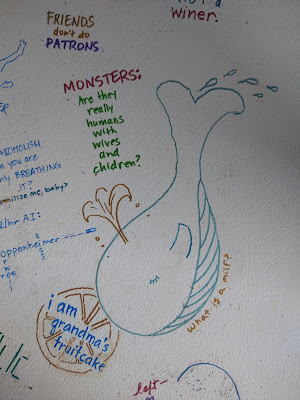
| Thar' she blows! Digital Art, NFT, $2.2M USD, $2M in proceeds go to the Anti-Defamation League. |
My writing here was made possible through the work my husband did while I was raising our kids. I feel like this is important to talk about in this context because we are all connected. My writing has been an attempt to document some common thread of what it is to be human. It was to ask the question of what the Christ Consciousness is and how we can embody it. I believe it is analogous to Buddha, Zen and other spiritual Consciousness (including but not limited to Judaica and Islam) and that it is these consciousnesses that connect us all. I believe that it is cultivated daily through our collective acts of kindness. What I found is that it does not happen without sex or at the very least rest, and that modern corporate life, Christofascism and other misogynist spiritual beliefs are thus tremendous hindrances to a person’s healthy relationship to themselves and others. I learned this through careful observation of myself and also listening to the stories of extended family and friends. I shared some version of these beliefs with our clients, concentrating on my theory that it is based on a metabolic energy, and it was the day after I did that I was apparently censored by China.
In my previous writing I had wondered what kind of father and partner Musk is; and I was thinking I could probably guess from what kind of employer he is and his behavior in the media. If I remember right from listening to his biography years ago, even as a child he felt alienated. He is behaving exactly like a cis-gendered heterosexual male who doesn’t know how to get his needs for connection met or how to have interdependent consensual relationships with women. As a result, he uses his money to lure them into bearing his children under the guise of having “free sexual relationships” where he can serve as an absentee father. Because he is wealthy, he can find ways to get around laws against prostitution by spoiling women with material goods like horses in exchange for the happy endings he desires. If prostitution were actually legal, he could get his needs met without wrecking women and children in the process. In the press, at the very least, it seems like he has a mood disorder and a desire to subtly control others, and it is interesting to me that he sees Mars as a place we should not bring diversity and inclusion (it is looking more and more like a potential political refuge for wealthy CEOs who treat women and children like they are disposable the more he speaks).
Unfortunately, my husband and I know all too well what it is like to work for people with these personality traits. It’s where I came up with the idea that “trickle down economics” simply amounts to how much overflow drips down from the golden toilet above. Getting any sort of sense of gratification from working for people like that is highly unlikely. They hire people to bear the pain of their tremendous egos for them, perform the material tasks they cannot, and in their wake, they leave people with heart attacks, anxiety, depression, suicidal ideation, and divorce. They are people who do not recognize signs of exhaustion in themselves, and so do not care about them in their workforce. I have come across quite a few people who held the belief that people who cannot perform their work duties on the timeline expected were lesser because of having itinerant fathers and critical mothers. I have also met many people who struggled with critical beliefs about the superiority of people with good health because of Christofascist family. The downstream effects of those mindsets were offspring plagued with self esteem, addiction and anger management problems. I know of one family through my genealogy research which struggled with a patrilineally inherited intolerance for women and Irish people which may have contributed to the institutionalization of a female ancestor during the Depression. I think the cumulative trauma over generations in that family was not uncommon and was related to men predisposed to Type A personalities and poor cardiac health being married to women who are more prone to dementia and mental health issues. Dementia is associated with having been a caretaker, and caring for an angry man with sacred sperm in the context of raising children is probably rather traumatic. This is just one important reason why Christofascism and the forcing of women into motherhood is so dangerous for society.
Years ago, I read a bunch of books on sociopathy and learned that most sociopaths are not in prison, but are business executives, doctors and lawyers. A sociopath has absolutely no sincere regard for their common man. That being said, in these elites’ defense, they are not all sociopaths, and a lot of life’s decisions involve the Trolley Problem. In my mind, there is only one Trolley Problem that matters, and that is the one of rewarding the sociopath or one’s common person who is capable of demonstrating consciousness. When a powerful executive continually makes statements which demonstrate an inability to care about the welfare of others or admit they don’t know everything, and simultaneously expresses distrust of society’s efforts to produce caring and conscious environments, and says we are not allowed to point out the error of their ways, we are risking becoming a plutocracy. Musk has a lot of work to do in this regard to repair his relationship with the US which supported him, and so do Biden and Trump. Musk acts entitled to people’s lives, and it makes him look like a tyrant. He needs to be held accountable for his use of psychological abuse, neoslavery and fear of consciousness in the workplace. It is never acceptable to bully people into compliance. Biden is showing his true colors, too - he turned snipers on his own supporters.
Furthermore, I do not understand how the space program became more important than the lives of people on this planet during a pandemic when we still do not have the science to enable all of us to live on Mars or even the Moon. I sincerely doubt that our astronaut who is stuck on the space station wants anyone to die or lose their cognitive or other potential in the course of rescuing her. She had to be brave to do what she did and was likely well aware that she could have died on the way out there in the first place, so it simply doesn’t make sense to put the lives of so many other people to rescue her, unless they really do want to take that risk and mitigate the potential fallout for the people who are close to them. Furthermore, it is highly unlikely we will find scientific discoveries that will help us to live more consciously with COVID on Earth through that exploration, and that is what we need to do to make space travel actually worthwhile, because it’s looking like we’ll be taking COVID with us wherever we go. Moreover, without adequate consideration of what is being left behind on Earth, the space program is simply treating it like a disposable booster rocket for the wealthy. How SpaceX employees are unable to see how they are unlikely to be the people to benefit from the technology they are developing is perplexing. Neither their families or social acquaintances, or anyone else without $100,000USD in disposable income is likely to benefit, either. They’re exactly the kind of people who will be left behind on earth to clean up the environmental mess made by men trying to get to the moon misunderstanding the purpose of philanthropy. My guess is that the people who are so concerned with keeping a launch schedule during a pandemic are fairly well paid (perhaps not enough to take the wife and fam), and it is exactly these sorts of people who enable the behaviors of sociopathic plutocrats. I wonder how many of them are aware of or even care how he treats the employees in China, or have made the realization that he sees all his employees the same, but sees the United States’ employees’ non-communist government worker protections as a barrier to his success, and those employees who dare to speak up as lazy vagrants (a term invented specifically for the purpose of channeling potential workers into the prison system to support hard labor) rather than people who fight for the creativity and health of all.
Unfortunately, Musk’s Yes People (let’s be inclusive, since SpaceX’s CEO Shotwell is female) are enabling the foreign corporate despotism that he is practicing. He is a despot; he makes unilateral decisions about foreign policy while presumably representing our nation for his own benefit, which is treasonous. Apparently we have allowed him to purchase and control one of the world’s most important communication platforms for big ideas, so it will be interesting to see if he remains the staunch advocate for free speech when people start posting scathing criticism of his blind spots like I plan to do. I confess it is hard for me to want to spend time reading opposing viewpoints when they are not well supported or rely on unfair fighting tactics like name calling, so it would be good if the criticism was pragmatic. I actually thought long and hard about calling him a despot or tyrant, and I also desperately want to believe that he can make peace with his daughter and reform his behavior with respect to the treatment of his employees. My husband is a lot more cutting with his assessments of people; Musk is lucky I try to give people a chance to change. Some people make that exceedingly difficult, and I have to triage those people to lower attention priority out of necessity for my mental health. Psychoanalyzing people for my own benefit doesn’t feel right, but in the case of people who have enjoyed unlimited power, they need to be open to such criticism if we are to let them have *any* power, so I hope those people who understand these psychological issues better will develop my argument further if they find it worthwhile.
 |
| If wishes were seahorses, men would be showing up to support caring issues, rather than just corporatism. |
Conservatives complain excessively about poor immigrants, but the truth is that they are the imported underclass who make life easier for the rest of us by doing the jobs we don't want to do. They often put their lives at great jeopardy just to get here, just like many of our immigrant ancestors did. That being said, right-wingers would rather we not import our burger-flippers and dog walkers, but then insinuate that people with those jobs don’t deserve a living wage, either. Then, conservatives and neoliberals alike say nothing about foreign corporate despots or their land and resource consumption or how their ambitious drive hurts citizens, impinges on their freedom, or fractures families and communities. Conservatives do this while claiming that they are not contributing to the New World Order, when in fact they are the very ones manifesting it through facilitating dependence on foreign energy. What’s really screwed up about how I figured this out is that I had to compete with mostly foreign nationals for work opportunities, for jobs that were abusive in nature and didn’t pay particularly well considering the education required. Many Chinese and Indian lab technicians I met were doctors and had gone to medical school in their home countries, but were making not much more than gas station attendants here. They are particularly good at their work and should be paid more for what they do. Technician jobs don’t always pay well and there are some strange risks involved in the work (like accidental infection and poisoning). I worked for a place that hired me and promised me a paycheck only for that paycheck to be unreliable as the corporate leadership was chasing the sale of their intellectual property. I actually knew another geoscientist who worked in an unpaid capacity for another company hoping for a paycheck for many years. He was hired for a paid position, but the company fell on hard times. A basic living wage would enable our science to progress when principal investigators can’t afford to pay employees. A basic living wage would not cause a shortage of manual labor, but would allow people who benefit physically and mentally from those sorts of employment opportunities to contribute to society in the way that most benefits them. Desk work is not particularly health or consciousness-promoting work, and I know people who are aware of that and have consciously chosen manual work.
Adding insult to injury for the average world citizen (since everything we do here affects the rest of the world), United States consumer protections have been relatively poor in recent years, and this is certainly another manner in which the wealthy have stolen from the rest of us. This has become one of the biggest issues for Tesla, notwithstanding the misrepresentation of the carbon impact of the supercharging stations, which are apparently powered by diesel generators at a net energy loss compared to just driving a diesel vehicle, because generators are highly inefficient. We just don’t have solar or wind technology where it needs to be to quickly charge an electric vehicle yet for long distance travel. In any case, with respect to reliability, I’ve had some interesting conversations with appliance repair and maintenance people in the last few years, and was surprised to learn things like the average life of a refrigerator is only 7 years, and that whole house A/C units are only designed to last 12 years. I don’t know if that information is actually true, but it is what the service people told me, and if it’s true, that’s nothing. That amount of time goes by in the blink of an eye when you have a life worth living, and you’re not stuck constantly replacing things that broke prematurely. I once shared in my writing that a mechanical engineering college friend of ours received a big bonus from the inkjet printer company he worked for by designing a part that would fail precisely after a certain number of duty cycles, rendering the printer useless at that point. There is no incentive for a company to make things well or long-lasting except the reputation they have with their customers, so the onus is on us to be honest about how they have harmed us.
I hate feeling like I have been duped by companies because of planned obsolescence or slippery marketing. In the case of slippery marketing, it comes in many forms which can have the effect of using more of our lives than these companies deserve for what they provide. One example I think of every day is the toaster my mother bought for us at the local big box store when she couldn’t figure out how to use my multifunctional microwave. A toaster is a fairly simple device, but the one she purchased, because she was at the store and didn’t read reviews, ended up barely functioning as a useful toaster. Since my multifunctional microwave eventually reached its end of use, I still use the impulsively-purchased toaster everyday to remind myself of the burden of poorly designed shiny things purchased impulsively in big box stores. I actually think big box stores rely on selling products that are more aesthetically appealing than they are functional with high markup because it is necessary for them to exist due to the cost of real estate. Furthermore, many products ask that you provide personal information for warranty programs which mostly serve to enable the selling of our personal information, which of course then ends up taking up more of our time and attention. The other thing I think of everyday is how many things I purchased online which I only need a limited amount of from companies which then market those same products to me sometimes multiple times in the same day everyday through push marketing in my email. That is an extreme example, but there is a certain clothing retailer that seems to think I need to purchase jeans multiple times a week. I’ve purchased from enough retailers over the years that I have an email address dedicated especially to these sorts of transactions, and I learned the other day that it was 97 percent full. I had over 69,000 unread emails, which I spent an hour paring down to just under 64,000 the other day, but it is now over 64,000 again. Up until a few years ago when I decided I had it with such marketing, I used to spend time each morning culling these emails. What an absolute waste of time and attention. I think there should be legislation enacted to limit this sort of marketing to once a week at the most. If we can’t persuade them to reduce the frequency of their mailings, perhaps we can start a movement to open new email addresses for these kind of transactions and boycott retailers who don’t comply. I feel like the sheer volume of time spent by the average US citizen slogging through these marketing efforts is not only theft of our potential, but also has the effect of wearing us down so that people are more likely to make impulsive purchases of things we don’t really need.
Academic, corporate and government employment are currently the only ways to receive truly stable employment and a hopefully living wage at this time, unfortunately, and those types of jobs aren’t a good fit for everyone. Furthermore, those institutions take care of administrative tasks like accounting and benefits negotiations on the behalf of employees that my husband and I haven’t enjoyed in a long time due to having been freelancing for the last 12 years. I wish these things were easier and more equitable for the self-employed, or that they were things nobody really had to worry about, since they seem to be a major source of inequity. I was compensated for time I spent working on these things, but because of my neurodiversity issues the work impacted my mood and creativity in ways that made it difficult to pursue the things I actually enjoy. In other words - while I was compensated for the time spent doing the activities, they actually harmed my being and mental health in ways that made the compensation bittersweet. I didn’t make enough money to treat those health problems completely, so I’m not sure that work opportunity was worth it. I think it may have been a net negative, but I can’t say for sure. My husband was very thankful I did that work, because it affects his mood, too. He also has neurodiversity issues with respect to paperwork minutiae. It’s for these reasons I’m not looking forward to trying to make it in the gig economy, because I don’t particularly enjoy accounting or paperwork due to how they cause my autism symptoms to flare. Even when I work on genealogy, I can’t be as detailed as other people. Bill Maher has been particularly insensitive to people who don’t want to work under pandemic conditions, and it dawned on me that as someone who obviously enjoys his job, it’s not really fair for him to judge people who have to do painful jobs. I do see that since I started composing this essay he has come out in favor of a basic living wage, so maybe he is softening, although I’m not sure he understands how much funerals cost. That’s why when I failed to receive medical care for my long haul issues I decided to have my husband dispose of my body in our chest freezer until he could figure out what to do with it. I don’t want him using his eating money to dispose of my body. Since we don’t choose to be born, it seems like parents should cover funerals, anyway. I think if a parent actually has something to pass along when they die, it should be the cost of each child’s funeral, especially the ones that had the most problems. I think respect goes the wrong way in our culture, because once you’re born due to your parents’ blind optimism or carelessness, you’re carrying their bad karma with you throughout your whole life. And for that matter, if we can’t have abortion, we should at the very least have assisted suicide for any reason at all. Any at all. No questions asked. Nobody makes that decision lightly.
There are jobs that might not seem painful, but which can be painful for a person who is the wrong fit or who has a disability and has not found a truly accommodating profession. Jill Bolte Taylor is a neuroscientist who discusses the health issues related to working in left-brain environments, especially for people with traumatic brain injury (which is actually a lot of people, because life is inherently bumpy and we don’t spend all our days wearing helmets). Very few workplaces and professions are actually accommodating to this common situation, and it is amazing how nuanced it really is. I was just reading the Wikipedia article on Peter Matthiessen who wrote The Snow Leopard the other day. He is the only person to have received the National Book Award for both fiction and non-fiction, and he said that writing nonfiction affected his thinking in a way he did not like. I am wondering if what he was describing is the same kind of thing I experience. I definitely feel more stressed after writing an analytical prose piece than I do after writing fiction or poetry. (I am actually excited to finish editing this piece soon so I can do something less painful, but my family keeps coming to me with more disturbing news, so I keep adding to the hairball). It seems like doing left-brained activity activates pain pathways or something, and if I remember right, that is what Dr. Taylor says as well. In Neuropsychology of the Unconscious by Ginot, activation of the right brain helps with trauma processing, whereas left brain dominant states lead to difficulties with emotional processing. I actually wrote the first iteration of this essay in a right-brain dominant state, but am editing it in a left-brain dominant state for accuracy, because the way I initially expressed the recollection of this trauma was so emotional that the emotion may have worked against the factual nature of the information I was trying to provide. These things make me upset because they are ways that my husband and myself experienced great trauma, but I need to make sure that my assessment of the situations are put in such a way that they help employers do better rather than just be angry for all the potential we lost. In any case, I got rid of our long standing health insurance policy when my husband quit because we could no longer afford the monthly premiums. Medicaid, which is health insurance provided by the US government for unemployed people, will be what we have to use during the months we receive income below the threshold set by the government. I have a friend whose income fluctuated a lot month to month before Obamacare, and she was constantly having to requalify for Government coverage during the months when their income was low. It sounded like a nightmare, then, and I’m not looking forward to it. I’m seeing a lot of good reasons to remain poor right now, because we have paid a lot of money into the insurance system and I haven’t gotten a lot of help from doctors. I just don’t understand the logic of paying our hard-earned money into a system I very rarely use or benefit from because doctor visits exacerbate my symptoms, I think because of the cleaning chemicals. I react at the big box stores, too (which contributes to impulsive purchases). Furthermore, the system still has no approach for treating long haul COVID; why would I want to make more money so I can pay $1200 a month while I wait for this neuro referral that is apparently never going to manifest for symptoms I had to figure out how to treat on my own? Talk about inhumane; Biden, Trump and Musk have all turned a blind eye to how these issues impact the workforce or how the compulsion to work and pay attention to excessive corporate marketing for unnecessary products impacts the physical and mental health of our supposedly “free” country.
 |
| The problem with attorneys and mind-body issues. |
That all being said, our craziest employment stories come from the Canadian employer my husband worked for when we first had children. There was a tremendous amount of surveillance and emphasis on bureaucracy, meetings, and process (they love this word), and the employees were uniformly not happy. Additionally, there was an opioid addiction problem in the office that did affect the work environment, perhaps as an outgrowth of the left-brained work they were doing, and the resulting pain. I did notice that Musk allows his factory workers to listen to music, so that’s good. I watched a documentary a few years ago about methamphetamine addiction and did not know that it arises from dependencies created by prescriptions for drugs for attention disorders, or that these drugs are often abused in the tech sector in particular. The time we lived in a conservative area and he worked for this employer was one of the hardest periods of our marriage. I’ve known a lot of other families, and it is incredible how the quality of the work environment affects the employee family environments. I guess my advice to anyone considering marriage would be that no income is worth the kind of torture some employers use, and it’s better to live poor than support that kind of indenture or feel like you have to. When I read Musk’s biography, the message between the lines to me was that he might be one of the most ambitious and insensitive men living. I hope I was not the only person who read that between the lines. I was trying to juxtapose him with Trump in my mind before, but now I see they are actually similar vice-wise and in terms of how they let their insecurity and ambition affect how they treat people both personally and professionally. There are good employers out there, but after experiencing enough bad ones it is hard to want to work for another person again, because of how painful it is to discover that poor treatment of employees was hidden during the interview process. One place my husband worked was notorious for its owner’s verbal abuse of employees, and it was something my husband got to witness happening to his colleagues. He was often asked to come in on weekends as well, and was afraid to say no until he found another job.
Furthermore, when we had our first child my husband was only allowed to take two sick days which unfortunately were taken by my long labor, so in my postpartum time getting to know our son I was having to manage without my partner, and then his parents showed up unannounced at our door from out of state while I was trying to get the hang of breastfeeding. Because the company he worked for had less than 50 employees, he was not eligible for the Family Medical Leave Act. We worked for a lot of small companies, and so things were always rather difficult in terms of feeling like he could take time off. I think it’s probably a similar feeling for teachers in education (maybe less so for administrative and other support staff, but it makes me wonder if a teacher is more likely to try to time a pregnancy for delivery in the summer). In fact, even though he was employed at a different company for my second birth, he also had to return to work after just a few days. He didn’t really get to work from home until he started doing contract work, and while it was initially a difficult transition to mix his work with the kids’ and my home life, he became more and more relaxed as time passed and he felt freer from the compulsion to emulate a traditional work schedule. I’m pretty sure he always hit his deadlines. He never mentioned being late. My understanding is that he was often too fast completing his work assignments, which meant he was often waiting around for other parts of the teams he was on to report back, and he has learned he would rather do the waiting in the comfort of his own home. When he was working at home figuring out how to use his free time was less of a big deal. He could have taken on other work, but was trying to remain available for our client since we thought they were paying us enough (although it turns out we didn’t adequately factor in some burdens on our mental health from the resulting isolation and having to a standalone rock and island without enough money to pay for repairs or improvements to our property that we didn’t perform ourselves). They were forgiving when my husband had several health crises, which I appreciate, and understood that those crises were likely linked to extra pressure he was under because the end of the fiscal year lined up with the holidays. I think work PTSD is a real thing, especially for people who dealt with a lot of unreasonable reach into their personal lives by their employers. Making work from home standard would help a lot of these workers, or at least having an extremely liberal attendance policy. Nevertheless, I still question the wisdom of making people work, during a pandemic, making things people don’t need with resources and time we don’t have on our planet.
Our cars have low mileage for their ages, due to homeschooling and working from home, even though for many years the kids and I drove around quite a bit for social and educational opportunities. I would think that a person who was ostensibly concerned about the environment and selling more “earth friendly” transportation alternatives like Musk does would see that if more people worked from home that would have a bigger impact on the environment than replacing every fuel powered car. Not that he has to be Christ or anything (even though he threw out the ‘ol Christian line, and having been Christian, those of us who truly believed tried to do that), but his work commute is something like 72 miles round trip, which isn’t really sustainable. My Dad gave me a good tip many years ago, and that was to live close to where we’re employed. Sometimes it doesn’t work out that way, unfortunately. But you’d think with a tiny house, it could. We ran into trouble purchasing homes and then having the close employment opportunity we had moved for not work out as well as we hoped in each place we lived. When I lived in Riverside, CA I got a dream job offer at UC Irvine working in neuroscience, but the traffic on the 91 freeway was not worth battling for the opportunity. Ultimately, my commute ended up being about 25 minutes each way back then and there were different routes I could choose. In any case, Musk’s commute is about twice as long as the longest commutes my husband and I had in our adult lives. I suppose because I didn’t really like my jobs, the commute may have been the best part of my day…
I don't like being poisoned by corporate negligence, nonetheless. I think it should be a fundamental human right to avoid poison. Nonetheless, the inclusion of poisons in our day to day life has become fairly ubiquitous. While I mentioned that driving a diesel is more fuel efficient than driving an electric vehicle charged using a diesel generator, it does not change the fact that diesel emissions are still very dangerous, or that the supply of oil and gas that is fracked in the US stands to disappear in the next few decades, especially if we each continue to shirk our personal responsibility in minding unnecessary consumption. But really, it is difficult to avoid poisons in modern life. The vanity business makes a lot of money trying to convince us that poisons are okay to use if they make us look pretty. I was never a big makeup wearer, and a lot of that is because kids don’t care if you wear makeup, so as a stay at home mom I could be myself. When I started leaving my house more a few years before COVID, I went through a phase where I experimented with makeup. It was rather expensive. I’ve heard some people say that as a woman in order to be taken seriously you have to wear makeup and have a stylish haircut. So I did that for a while. But anyway, I was talking about poison because mesothelioma has been linked to the talc used in eyeshadows and blushes. And then there’s formaldehyde and VOCs in shampoos, according to the series Not So Pretty. I’ve had discussions with engineers and chemists about these things in the past (almost always male), and I still remember how they would dismiss these concerns, so I’m excited to see their faces when they see that air quality meters clearly demonstrate that their “but the dose equals the poison!” logic led to overuse and bioaccumulation of these compounds at detectable levels in the environment! I don’t think many white men believe these things could cause harm because they disproportionately affect women and children because of our smaller body sizes, but also because women have higher circulating levels of estrogen. I use a bar shampoo now, but before that I was getting “natural” shampoos and conditioners. I paid a lot at the salon for this shampoo that I thought made my hair gorgeous and which contained alcohols, but it was really just learning about how to style my hair that made a difference. The bar shampoo works well enough, and it spares the world a plastic bottle. In any case, a good portion of the makeup I bought, including the high end stuff, had talc in it, and I’m having to throw it away. I’m not feeling like rewarding that industry by purchasing any more. Someone I know very well had uterine cancer last year and regularly used baby powder in their underwear, so this is something close to my heart.
 |
| Is there a cosmetics poison recovery per diem for working expenses? |
What chemists usually have to do in these situations is come up with something to replace whatever ingredient got banned, and what they choose isn’t always better. In the case of bisphenol-A (BPA), the replacement was found to be cancer causing as well. I knew a couple people who made their own personal care products not just for these reasons, but also to minimize packaging and reduce their expenses. I think chronic acne may largely be a result of sensitivity to shampoos and face products. For a few years I discontinued use of these products, but then started using shampoo again. Really, baking soda and vinegar were sufficient. I have a fairly large amount of Native American ancestry, so I often think of how those ancestors didn’t use those things and still found ways to subsist and still reproduce, ostensibly without having self-esteem problems that prevented them from living their lives. *chuckle* How we ever got to the point where a small bottle of shampoo could cost the same as two and a half hours of minimum wage work, I have no clue, and how someone on a stylists’ pay could in good conscience sell that to other people, I also don’t know.
 |
| Admixture results for this purported "Alien" from 23andMe. |
I don’t like buying things that are a waste of my money and time, or which make me sick. I have wasted a lot of my life on things like this, and because of having been in the manufacturing industry working on a technology to curtail waste, I have significant opinions about what waste actually is. I tried to avoid purchasing wasteful things, but often one finds out later that a product was not designed or manufactured as well as it might have been. I also don’t like purchasing products whose creation involved mistreatment of other human beings. Unfortunately, one of our client’s customers included a manufacturer often used by Apple which was unfairly imprisoning its workers. I think the watchers of industry in this way are missing the forest for the trees; in particular, the automated inspection industry my husband was so critical to enabled people with bad or superfluous designs or products to assuage any guilt they might have for the ways they were misusing our planet for profit, by purchasing inspection machines. I know the intention was to help the manufacturing industry police itself better, but I think there needs to be better discernment about what we even bother to produce, because a lot of what’s on the market amounts to things that make life harder for people because of those things’ very existence, toxic nature, and subsequent need for curation. The inspection industry, I feel, is thus involved in the resource-expensive process of polishing wealthy peoples’ money-making idea turds, which we wouldn’t have to do if they could learn to live with less money and we were more selective about what kinds of ideas go to market..
We were very close to being involved with Tesla as a customer. We left before that decision could be made. Too much liability was placed on my husband and I. Furthermore a key person in the business who said they would be there for us no matter what just wasn't at a very difficult time. Two companies used us to get rich by having us bear the liability of the burden of their technology transfer. And they did not share the wealth considering how critical we were to the success of the transfer, how successful the transferred product was, and how important it supposedly was to the entire electronics industry. I just read a piece about how people in our station often had a lot handed to us in terms of financial assistance. We were fortunate that our parents helped pay for our college educations (we still had educational loans, however, and I agree with Bill Maher that it doesn’t make sense for the uneducated to bear the cost of student loan forgiveness). But we were both working in graduate school and except for a little help we got with the downpayment on our first house, and our client and my parents sometimes taking us on trips, we had to find and make our own opportunities. They didn’t land at our feet or anything. In terms of the freelance work and the technology transfer, that was something my husband and his coworker decided to negotiate for themselves, and the coworker kind of got screwed over (they wouldn’t hire him full time, so he ended up having to find other employment).
 |
| My favorite donkey... |
We were often told that technology transfer of complicated products to other countries was rarely successful. Generally speaking, most companies we worked with over the years rewarded management and the sales force over the people who made the technology actually possible through solving difficult design problems (and often the people who did design had a higher levels of education than the managers and sales force, who didn’t really understand the complexities of the product they were marketing). I understand that networking and marketing are what help ideas fly, but I do not understand why the creators and developers of intellectual property are not rewarded better for their critical contribution, or why their work often involves abuse. Ultimately, we felt that was not the way for us to best exist, because it was hurting our connection to the community and also our mental health. There was a brass ceiling we needed to pass through to protect ourselves from the kind of liability we were expected to bear in that situation, especially when working for such volatile entities. We were never given the security or help we needed to feel confident about that level of involvement, especially for a technology we ended up being involved in just for want of a paycheck, and which may not be as essential or beneficial as we were led to believe. I don't think either one of us wanted to be involved in anything that would put us in the middle of some sort of international supply chain crisis, or lead us to be targets of surveillance, censorship or espionage, and I know we don’t want to now.
Even before we learned all these things, it was difficult to find work for companies we felt weren’t doing harm. That’s because, even though it might not look like it, we are actually very concerned with living ethically in our dealings with others and society. My husband turned down a job for a local company owned by the French who we both felt was developing intrusive surveillance technology, and he has refused to work with defense contractors in the past. The nail in the coffin on that deal was psychological manipulation they tried to use during salary negotiation. There are probably some red flags related to pre-employment hiring practices that he could share, which I won’t do justice. I know one defense contractor out of state refused to compensate him for a rental car for his interview when we were students. They didn’t want to provide him with a way to explore the area we would end up living in. So he just didn’t use the plane ticket they purchased for him. We actually moved from an area because too many of the employment opportunities were defense related. It is difficult when a person has the skillsets the two of us do to not get caught up in something nefarious with respect to developing technology that might cause harm to life. When We Cease to Understand the World is on my list of things to read and it discusses the myriad moral consequences of scientific discovery. My husband and I are concerned with not becoming unwitting Oppenheimers, because together we are a think tank, and many things we have discussed over the years have become successful products. So anyway, we’re the kind of people where we want to be very careful who we let at our ideas, because we could easily be taken advantage of and lose our autonomy to someone just like Musk, never able to question his ways or pursue our own ideas. And that, my friends, is what it was like working for other people in almost every situation besides academia.
Both my husband and I had other types of employment before going to graduate school. We both worked as bussers in restaurants, and he did some work as a line chef. I worked for a restaurant which sometimes made me come in two hours before they let me start my shift, and at the time I was making less than $5 USD/hr. He did break a picket line over the summer when we were in college, because the protest was not over wages, but over an altercation between a male and a female employee, and the men didn’t like how it went. He worked the night shift then, and got damage to his car from the protesters. I once had more than one job at the same time - when I was doing the restaurant work, I also did secretarial work for a title company. So the restaurant requiring me to come in two hours early was particularly awful, considering my other job paid twice as much. I did a lot of secretarial work starting as soon as I turned 16. Every summer during college I worked a temporary secretarial job, and learned about different industries. I worked in the medical device industry creating databases to keep track of data for recalled products, for the energy industry as a human resources termination specialist, and also in general construction as a receptionist. I never felt abused at those jobs. My husband and I also worked in the event planning industry throwing large company picnics where we did things like paint faces, sell concessions, supervise bounce houses and operate carnival games. That work paid well but was infrequent. My first job, however, was entering journal abstracts into a department database for the chair of the Molecular Biology Department at CU. When I did that, I didn’t understand anything I was typing, which I find so funny now because I ended up studying molecular biology in graduate school. Also, it’s ironic because that’s an arcane job due to Pubmed. Part of that job was also filing the applications for graduate students. That’s when I learned that it was rare for US citizens to want to be scientists, and I started seeing the complicated nature of scientific intellectual property with respect to national borders.
So anyway, with respect to work, I am not sure what the best way to proceed for me is. I suspect I might be exceptionally vulnerable to COVID, and it’s my understanding that nobody is really wearing masks in the office anymore. It’s kind of odd to watch all the news about diversity and inclusion when people with vulnerability to COVID or who are suffering from the effects of long haul COVID are simply not being considered. I am pretty sure I had another breakthrough infection recently, because the other times I had COVID I had a day where I woke up with crusty eyes, and my eyes were watery the same day and my tears burned. Later there were GI issues. I also had trouble sleeping, and major exacerbation of my neurological, concentration, and mood issues, except that I did not lose my sense of smell. When this has happened I take care to communicate my symptoms with others in my house and compare notes. I try to do this in a way where it is written down because I swear the others don’t keep track of what happens in their lives, and so they forget while I am on a constant roller coaster of them feeling like it is dangerous and staying in or suddenly feeling like they need to see people. My conditions are largely governed by whatever false hope public health officials are spreading. In the context of learning that immunity to omicron or its subvariants is not well produced by either vaccination or infection, I admit I became a little nihilistic about how my quality of life stands to look with public health officials doing nothing to encourage actual personal responsibility in terms of minding the frequency of time spent unmasked with others. But then, because I am weird like I am, I remembered that I am not even close to alone fighting these awful symptoms. I have a protocol that mostly works, but I have to stay on top of it, and I get tired of having to think about it when there are too many other details for me to focus on and my cognition is slowed significantly. I’m at this point in my life where I need my self care to be “set it and forget it,” but because of the shifting landscape of COVID public health policy, breakthrough infections and accidental poisoning from my neighbors’ yard-related shenanigans, I’m constantly having to treat symptoms.
Fortunately for my argument, there is a new Netflix movie called Spiderhead which demonstrated what happens to me in a sort of grandiloquent way. Having been a behavioral neuroscientist, and also having just watched A Clockwork Orange all the way through for the first time, the parallels with what I have learned through my own experience, my graduate research, and also listening to the stories of others were remarkable. I haven’t spoken about this much in my nonfiction writing, but my dissertation work actually cast great doubt on many of the interpretations we draw in our field about human behavior from standard animal behavioral assays. In both Spiderhead and A Clockwork Orange, mind control experiments are performed on human beings in an attempt to rehabilitate prisoners. In my own research, I was looking at the effect of estrogen on learning and memory in ovariectomized mice as a model for dementia, and I used two standard animal assays in my work. The first one was the Morris Water Maze, which uses a hidden platform in a circular pool of tinted water divided into quadrants to measure animals’ ability to remember where the experimenter put the platform. The second one was the Skinner Shuttle Box, which tests an animal’s ability to remember the context in which they were delivered an electric shock. During my thesis defense I was asked several pointed questions about what type of memory I believed I was measuring. I had completed a third of my research, but ran out of money to do the last two thirds, which intended to look at whether the “memory protection” effect of estrogen seen by other researchers was due to control of genetic expression by estrogen or an antioxidant effect. In the first third of my research, I found some interesting things. There was no statistically significant difference between treated and untreated animals in the Morris Water Maze test, but the animals’ behavior was fairly uniform between the two groups. The untreated group simply gave up trying to find the platform when I did the part of the assay where I removed it and measured how much time they spent in the target quadrant, whereas the treated group would swim beyond exhaustion. Moreover, half of my treated animals died. That haunts me. It haunts me for a few reasons, the first because I was a person who did not do well on hormonal contraception. I am not of the opinion that this is reason to remove access to hormonal contraception, however I do think it is important for women to understand potential risks and make decisions for themselves. I feel that way about all pharmaceuticals and medical interventions. I feel that the risks should be accurately conveyed. Secondly, at the time, I saw the placebo animals’ decision to stop trying at the time as laziness, but now I am pretty sure they were actually intelligent enough to figure out that the platform was gone. The treated animals were swimming around in a gaslit frenzy. When viewing their reactions in that way, it makes for a wildly different interpretation of that particular memory test. In some respect,s I see my attempts to continually reconcile the insanity that is going on in the world through this writing as searching for a platform that simply isn’t there, and wouldn’t you know it, progesterone and dopamine, which help modulate the physiological effects of estrogen and serotonin in the nervous system, help that anxious feeling go away. For this reason, I believe behavioral neuroscience needs to revisit the interpretation of data collected on both serotonin and estrogen. I believe it was largely misconstrued through anthropomorphizing animal persistence as intelligence rather than fear. The estrogen treated animals were significantly thinner, and it is possible that my control animals were more able to float. That seems somewhat like a metaphor for the human behavior I see all around me.
 |
| What you don't know *can* hurt you. |
Furthermore, what I feel is even more puzzling is that there absolutely was a statistically significant difference in learning between the two groups in the Skinner Shuttle Box. Estrogen treated animals were much more likely to remember what had happened on the day of training and took much less time to move to avoid the shock on testing day. I believe now, as a sufferer of PTSD, that I was not measuring any sort of healthy learning with that assay. I believe I showed that estrogen is an important mediator of Post Traumatic Stress induced memories. This has been an extremely difficult psychological burden to carry because I feel like I understand something about free will and the environmental and metabolic origins of anxiety that most people do not.
Oh, and for those concerned about vanity, my estrogen treatment group’s fur never grew back from where I shaved them for their surgeries (I had ovariectomized them). The way I thought back then, I got excited because I thought estrogen might be a good treatment for hirsutism. I didn’t see the lack of fur growing back as pathological, even though half of those animals died before the end of the experiment. I hope that story gives the reader insight into the mind of an idealistic capitalist scientist looking for effective and marketable treatments regardless of their side effects. The reason this story is so important is because so many things in the world are estrogenic. I think estrogen is an important factor in the development of many of the effects of long haul COVID.
I have been thinking about how many other people with long haul are women in my age category, and how we feel invisible. So I sent a letter to the doctor who claims to be the person pulling the strings behind Colorado's COVID public health policy letting her know how all of this was affecting me. I shared that I felt that governmental pandering to vaccine companies and anti-maskers (which now includes liberals for a double whammy) was making my life rather miserable. I also asked her to be wise and refrain from making projections, especially positive ones, about the direction of the pandemic because public health officials have always been wrong about it being over, and because of the trust the public puts in them, that particular behavior has cost people their lives, cognition, renal and cardiac health.
I haven't heard anything from this powerful infectious disease expert in response to my effort to advocate for others like myself despite providing intimate details about how COVID has affected my mental health struggle. Maybe she is busy checking her stonks after I pointed out that her industry's poor job at policing itself was becoming evident to biological scientists in other fields (but not necessarily the engineers we know, except my husband, since his undergraduate degree is in biomedical engineering). We cannot have such juvenile behavior running our public policy. It is this pandering to corporatism and white privilege, especially to the restaurant and travel industries and wealthy people who are worried about the end of their life becoming boring (wah!), that is crashing the economy, not "woke culture." It is disheartening to see doctors rewarding themselves with luxury vacations and advertising their love of restaurants during this time - it is like wealthy educated people have some sort of guilty pleasure conflict of interest that encourages the enslavement of hourly workers. I am not sure someone with as much money as a doctor has would honestly be able to see the plight of a person who was not as privileged. They are always going to have money for childcare, for one thing, and also to have their meals made for them every day of the week if they so desire. They and whichever family members they choose to let into their caring circle also have access to resources and treatments that regular people, even scientists, do not.
The sad truth is that this global predicament arose because the wealthy simply didn't take good care of their toys, which unfortunately happened to be us people to whom their pain is outsourced, and now the workforce is broken. Much to the dismay of the retired and the billionaires, derivative markets don't function well on the backs of actually broken people, and they are finding this out the hard way. I am choosing to take the lack of acknowledgement of my efforts to connect with clinicians for both my personal care and also regarding my concerns about long haul treatment and public health as evidence that they are not sure how to respond, not intelligent enough to respond, too powerless to do anything, too invested into a solution they think will be lucrative, or unsure how to tell me that I am actually broken from their perspective.